Building the Philippine Sky: Difference between revisions
Created page with "<html> <div style=" width:800px; max-width:100%; margin:0; padding:0; box-sizing:border-box; font-family:Arial,sans-serif; "> <!-- REPOSITORY HEADER IMAGE --> <div style=" width:800px; max-width:100%; margin:0 0 12px 0; padding:0; "> <img src="https://asxresearch.org/images/2/29/Servers.jpg" alt="ASX Academic Paper Repository" style=" display:..." |
No edit summary |
||
| Line 108: | Line 108: | ||
<div style="padding:18px 20px; font-size:16px; line-height:1.65;"> | <div style="padding:18px 20px; font-size:16px; line-height:1.65;"> | ||
<h2 style="font-family:Arial,sans-serif; text-align:center; margin-top:0;"> | <h2 style="font-family:Arial,sans-serif; text-align:center; margin-top:0;">Building the Philippine Sky: Modernizing the National Airspace System and the Airports That Sustain It</h2> | ||
<p style="text-align:center;"> | <p style="text-align:center;"> | ||
Albert N. Clark<br> | Albert N. Clark<br> | ||
Independent Author<br> | Independent Author<br> | ||
Published: September | Published: September 4, 2026<br> | ||
ASX Research Journal and Database<br> | ASX Research Journal and Database<br> | ||
ISSN 3068-3351 (Online)<br> | ISSN 3068-3351 (Online)<br> | ||
| Line 133: | Line 133: | ||
<p> | <p> | ||
The Philippine | The Philippine aviation system is entering a decisive period of transition as sustained traffic growth, geographic complexity, strategic pressures, and infrastructure limitations force the country to rethink how its airports and national airspace are developed and connected. This article examines the historical evolution of Philippine aviation infrastructure, the present condition of Civil Aviation Authority of the Philippines air traffic management and communications, navigation, and surveillance systems, and the emerging multi-airport strategy centered on Manila, Clark, Sangley, Subic, and other regional gateways. Particular attention is given to the New Dumaguete Airport at Bacong as an example of how modern provincial airport development can improve regional connectivity, operational resilience, tourism, and economic integration. The article also evaluates the relatively underdeveloped role of general aviation in the Philippines, including its potential advantages for inter-island mobility, emergency response, business travel, and access to remote communities, while considering the operational challenges posed by tropical weather, terrain, over-water flight, limited maintenance and fuel support, and uneven airport capability. Strategic concerns associated with Chinese activity in the West Philippine Sea are assessed in relation to civil and general aviation operations, alongside the expanding but non-permanent role of U.S. military forces at Clark and other Philippine facilities. The analysis argues that future aviation growth will depend not simply on building more airports, but on creating an integrated, resilient, technologically advanced, and strategically adaptable national airspace system capable of supporting commercial aviation, general aviation, regional development, disaster response, and national security across the archipelago. | ||
</p> | </p> | ||
<p><i>Keywords:</i> Philippine | <p><i>Keywords:</i> Philippine aviation, airport modernization, national airspace system</p> | ||
<h3 style="font-family:Arial,sans-serif; text-align:center;"> | <h3 style="font-family:Arial,sans-serif; text-align:center;">Building the Philippine Sky: Modernizing the National Airspace System and the Airports That Sustain It</h3> | ||
<p> | <p> | ||
The | The geography of the Philippines makes aviation more than a transportation industry; it makes aviation part of the country’s physical nervous system. More than 7,000 islands are scattered across an archipelago whose economic centers, provincial capitals, tourist regions, military installations, and disaster-prone communities cannot be efficiently connected by surface transportation alone. Philippine aviation evolved from colonial-era military fields and relatively rudimentary domestic routes into a complex national network carrying scheduled airlines, cargo operators, military traffic, general aviation, training aircraft, helicopters, and increasingly unmanned systems. The creation of the Civil Aviation Authority of the Philippines under Republic Act No. 9497 in 2008 gave the state a modern institutional framework for regulating civil aviation, operating many airports, and providing air-navigation services, but the infrastructure it inherited was unevenly distributed and in many places already under pressure. That problem is becoming more consequential as Southeast Asian air travel expands. Sam Conrad Joyce, Ahmed Meeran, and Aanal Agrawal (2021) identified the Philippines as one of the Southeast Asian states likely to contribute substantially to future aviation growth, placing the country in the uncomfortable but promising position of having to modernize while traffic is already increasing. | ||
</p> | </p> | ||
<p> | <p> | ||
The | The central issue is therefore not simply whether the Philippines needs more airports. It needs a more capable national airspace system connecting airports of radically different size and sophistication into one resilient operating environment. CAAP’s communications, navigation, surveillance, and air traffic management infrastructure must support dense airline operations around Manila and Cebu while simultaneously serving provincial airports separated by mountains, water, tropical weather, volcanic hazards, typhoons, and long stretches of sparsely instrumented terrain. The Philippine air traffic flow management system was introduced in response to precisely this growth problem, and Masahiko Ishida (2014) found that its implementation reduced holding associated with congestion at Ninoy Aquino International Airport. That was an important advance, but flow management is fundamentally a method for making better use of existing capacity; it cannot indefinitely substitute for additional runway capacity, resilient communications, surveillance coverage, modern flight procedures, redundant power and data systems, or enough trained controllers. CAAP’s continuing program of hardware, software, communications, AMHS, VSAT, cybersecurity, and ATM-system upgrades demonstrates that modernization is now an ongoing process rather than a one-time acquisition. | ||
</p> | </p> | ||
<p> | <p> | ||
The | The human component is just as important as the equipment. A modern air traffic system can have superb displays, surveillance feeds, automation, and communications yet remain vulnerable if workload, fatigue, coordination, situation awareness, or training are inadequate. Miriam Bongo and Rosemary Seva (2023), studying controllers at CAAP’s Mactan control tower, identified situation awareness, communication, teamwork, vigilance, and attention among the causal factors shaping controller performance. That finding should be treated as strategic rather than merely occupational. Philippine airspace increasingly combines fast commercial jets, slower turboprops, military formations, training aircraft, helicopters, business aviation, unmanned systems, and international overflight traffic. CAAP’s 2026 guidance on air-traffic-flow management, contingency planning, navigation-aid status, meteorological coordination, rescue coordination, and controller fatigue therefore represents the less visible but indispensable side of modernization. A national airspace system is not modern because its radar screens look modern; it is modern when information survives failures, controllers retain an accurate mental picture during abnormal conditions, and an aircraft can move from one region of the archipelago to another without encountering a sharp degradation in procedural or technical support. | ||
</p> | </p> | ||
<p> | <p> | ||
Nowhere is the capacity problem more visible than Manila. NAIA’s intersecting runways, dense schedules, constrained urban footprint, mixed aircraft types, and enormous concentration of national traffic have made congestion a structural problem rather than a temporary inconvenience. Miriam Bongo and Lanndon Ocampo (2017) examined congestion mitigation at NAIA and found that aviation safety remained the dominant criterion when selecting air traffic flow-management responses, while their subsequent research showed how safety, economic value, system utilization, and other considerations interact in congestion decisions (Bongo & Ocampo, 2018). These findings remain relevant because there is a limit to what procedural efficiency can extract from a physically constrained airport. The Philippine answer is increasingly a multi-airport strategy rather than another attempt to force all Luzon demand through one gateway. NAIA can be improved operationally, but Clark, the developing New Manila International Airport, Sangley, and potentially Subic collectively provide something NAIA alone cannot: geographic distribution, additional runway capacity, cargo specialization, strategic redundancy, and the possibility of moving different categories of traffic to the facilities best suited to handle them. | |||
</p> | </p> | ||
<p> | <p> | ||
Sangley and Subic illustrate how quickly that multi-airport idea is becoming tangible. President Ferdinand Marcos Jr. directed the expedited development of Sangley Point International Airport through Administrative Order No. 44 in 2026, while the United States is funding a feasibility study intended in part to ensure strong security provisions for future direct U.S. services. Subic International Airport, meanwhile, entered the formal comparative-challenge stage of its public-private partnership process in August 2026 for modernization, expansion, operation, and maintenance. These are not interchangeable projects. Sangley could become a major component of the Manila metropolitan airport system; Subic has an unusual combination of aviation, logistics, free-port, industrial, maritime, and strategic characteristics. Tony Grubesic (2017), examining the evolution of general-aviation reliever airports, demonstrated that secondary airports can become economic centers in their own right rather than merely overflow facilities. That lesson is highly applicable to Luzon: the best future is not one in which Clark, Sangley, Subic, and Bulacan simply imitate NAIA, but one in which each develops complementary strengths while remaining connected by common airspace, ground transportation, cargo, and safety planning. | |||
</p> | </p> | ||
<p> | <p> | ||
The most interesting development outside Luzon may be the New Dumaguete Airport at Bacong, Negros Oriental, because it shows what modernization can mean at the provincial level. The existing Dumaguete-Sibulan Airport has significant physical and operational constraints, while the replacement airport is planned on approximately 197.55 hectares in Bacong. Current regional planning documents describe a 2,500-meter runway, associated taxiways, Category I instrument landing capability, a passenger terminal, communications and navigation systems, and support buildings, with operations targeted for 2029 and planning demand of approximately 2.45 million passengers by 2035. The project cost is approximately ₱17.05–17.06 billion, with substantial financing from South Korea through the Export-Import Bank of Korea, and the 2026 national budget contains ₱2.52 billion for the New Dumaguete Airport Development Project. The Department of Finance has described an increase from an existing capacity of roughly 800,000 passengers toward approximately 2.5 million annually and the potential opening of international routes. This is not simply a larger terminal replacing a smaller one; it is the opportunity to give southeastern Negros an airport designed around contemporary safety, instrument, capacity, and regional-development requirements from the beginning. | |||
</p> | </p> | ||
<p> | <p> | ||
Bacong also illustrates why airport development should be judged by the network it creates rather than the terminal it photographs well. Florian Allroggen and Robert Malina (2014) found that the economic effects of airports vary significantly according to connectivity and local conditions; airport concrete by itself does not guarantee development. A successful Bacong airport could strengthen the Dumaguete–Negros Oriental economy, support tourism to nearby Siquijor and the Central Visayas, improve access for universities and medical services, increase cargo possibilities, and provide an important alternate in the regional system. Tamilla Curtis and Wilfred Manuela (2025), studying inter-island air connectivity in the Bahamas, similarly demonstrate the importance of airport infrastructure and air service to island economies, a particularly useful analogue for the Philippines. The danger is building isolated capacity without creating dependable routes, ground connections, instrument capability, maintenance support, emergency services, and airline economics that sustain it. Bacong therefore deserves to be understood as a test of whether Philippine airport policy can progress from constructing facilities toward designing complete transportation ecosystems. | |||
</p> | </p> | ||
<p> | <p> | ||
General aviation is one of the least discussed pieces of that ecosystem. Philippine GA exists, but it is far smaller, less visible, and less institutionally cultivated than its counterpart in countries such as the United States. It includes flight schools, privately operated aircraft, business aviation, charter and air-taxi activity, helicopters, agricultural and other aerial work, medical transportation, corporate aircraft, and specialist missions. CAAP regulates aircraft registration, personnel licensing, airworthiness, maintenance, equipment, operations, and aerial work through the Philippine Civil Aviation Regulations, meaning GA is not an unregulated fringe of the national system. Yet its practical development is restricted by aircraft ownership costs, fuel availability, maintenance support, insurance, hangarage, parking, airport operating limitations, access to suitable alternates, weather, and the concentration of services at relatively few locations. Lucia Giovanelli and Federico Rotondo (2022) showed that airports can actively cultivate GA as a distinct market rather than merely tolerate it alongside airline traffic. That distinction matters in the Philippines because GA could perform economic and social functions for which scheduled airlines are poorly suited. | |||
</p> | </p> | ||
<p> | <p> | ||
For an appropriately equipped and competently flown aircraft, the Philippines is almost geographically designed to demonstrate the value of GA. A trip requiring ferries, buses, road transfers, and perhaps an overnight stay can sometimes become a direct flight measured in hours or minutes. Business travelers can reach secondary cities without returning through Manila; medical or technical personnel can reach isolated communities quickly; tourism can extend beyond established airline gateways; and disaster-response organizations can move people and critical supplies when roads and ports are disrupted. Xavier Fageda, Ancor Suárez-Alemán, Tomás Serebrisky, and Reinaldo Fioravanti (2019) found that public policy can preserve useful air connectivity in remote regions where purely commercial criteria would otherwise produce inadequate service. That logic is particularly powerful for an archipelago. Yet GA flying here also demands respect: tropical convective weather can develop rapidly, mountainous islands reduce forced-landing options, water crossings require survival planning, smaller airports may have limited hours and instrument capability, and fuel or maintenance may not be available where a pilot would expect them in a continental system. Tony Diana (2015) showed how satellite-based precision approaches can dramatically improve the utility of GA airports lacking traditional instrument landing systems; expanding modern performance-based navigation in the Philippines could similarly transform all-weather access without requiring an ILS at every runway. | |||
</p> | </p> | ||
<p> | <p> | ||
The proximity of China does not make ordinary GA travel around the Philippines inherently dangerous. A private flight between, for example, Cebu, Bacolod, Dumaguete, Iloilo, Bohol, Palawan, or Luzon is not automatically exposed to Chinese military activity simply because the countries are geographically close. The risk changes near disputed portions of the West Philippine Sea and particularly around places such as Scarborough Shoal, where Philippine government and military aircraft have encountered Chinese interception and harassment. In July 2026, China said its military tracked and warned three small Philippine aircraft near Scarborough Shoal, and previous incidents have included dangerous maneuvering and flare deployment around a Philippine Air Force aircraft. A prudent GA pilot therefore treats geopolitical airspace much as a professional crew treats volcanic ash, severe weather, or temporary restricted airspace: obtain current NOTAMs and briefings, remain well inside established Philippine routes unless the operation specifically requires otherwise, maintain communications, file an appropriate flight plan, and do not improvise sightseeing excursions into contested airspace. For normal domestic island travel, weather, aircraft condition, pilot proficiency, fuel planning, terrain, and over-water preparedness are generally much more immediate safety concerns than China. | |||
</p> | </p> | ||
<p> | <p> | ||
Nevertheless, strategic geography now has to influence national aviation planning because the same CNS and airport infrastructure that supports peaceful civil traffic may become indispensable during a crisis. Communications redundancy, surveillance coverage, protected data networks, dispersed airfields, alternate runways, resilient fuel storage, rapid runway repair, and the ability to reroute traffic are simultaneously civil-safety and national-resilience capabilities. The importance of regional airport infrastructure becomes especially clear when one considers typhoons, earthquakes, volcanic eruptions, cyberattack, military contingency, or the loss of a major hub. General aviation can contribute here as well: small aircraft and helicopters can operate missions that are economically irrational for an airliner and operationally inefficient for a heavy military transport. The broader research on remote-air connectivity by Fageda and colleagues (2019), together with Curtis and Manuela’s (2025) analysis of inter-island transportation, suggests that a distributed aviation network possesses social value beyond its commercial passenger count. In the Philippine context, redundancy should therefore be regarded not as excess airport capacity but as insurance for an island nation whose transportation links are intrinsically vulnerable. | |||
</p> | </p> | ||
<p> | <p> | ||
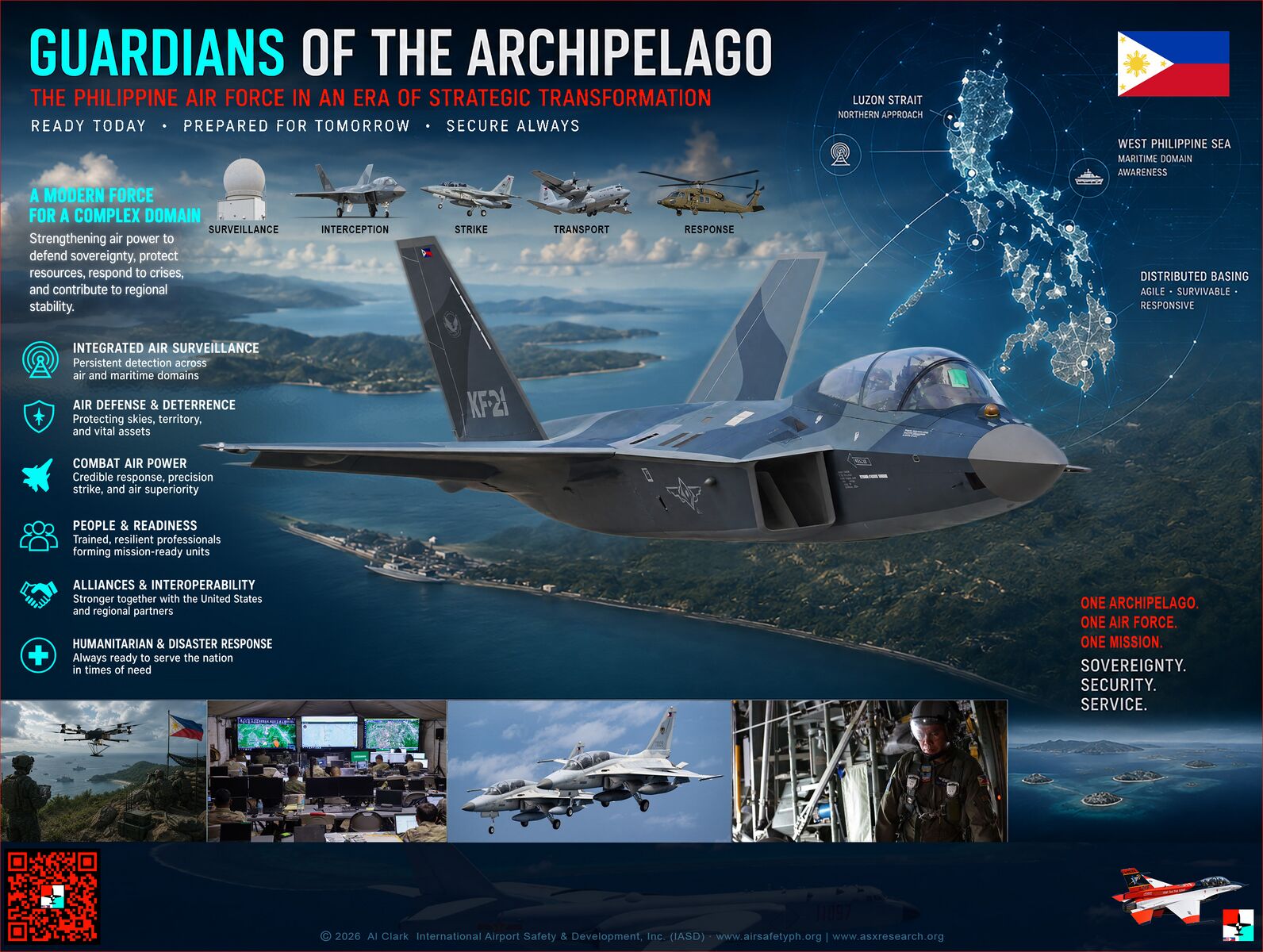
Clark International Airport occupies perhaps the most fascinating intersection of these civil, economic, and strategic roles. Built from the former American Clark Air Base, returned to Philippine control in 1991, Clark is today part of a 2,367-hectare civil aviation complex with a 3,200-meter runway system, international passenger operations, logistics activity, surrounding industrial development, and an enduring Philippine military presence. Arthur Dela Peña (2025) concluded in his assessment of next-generation aircraft operations at Clark that the airport possesses substantial potential but would require continuing infrastructure adaptation for unconventional future fleets, reinforcing a larger point: Clark is no longer simply a substitute for Manila; it is developing into an aviation center with its own strategic identity. The U.S. military has also unmistakably returned to Clark operationally, though not in the old permanent-basing sense. During Balikatan 2026, U.S. C-130J aircraft, Air Force personnel, multinational aeromedical units, and an Air Expeditionary Wing operated from Clark. That is a significant American military presence, but there has been no announced restoration of Clark as a permanent U.S.-controlled air base comparable to the pre-1991 arrangement. Philippine sovereignty remains the governing fact; what is expanding is rotational access, interoperability, exercises, contingency capability, and allied use. | |||
</p> | </p> | ||
<p> | <p> | ||
The distinction matters because the future Philippine aviation network may be simultaneously more civilian and more strategically useful. Clark, Subic, Sangley, Basa, Mactan, Puerto Princesa, and other facilities can provide civilian capacity while also supporting national defense and allied operations when required, without reproducing the political and legal structure of permanent foreign bases. The renewed U.S.–Philippine defense relationship makes it entirely plausible that Clark will see frequent American deployments, exercises, logistics activity, aeromedical operations, and transient aircraft; indeed, 2026 operations already demonstrate that reality. But describing this as the United States simply “moving back into Clark” would overstate what has occurred. The more consequential trend is distributed access across a Philippine-controlled network. That architecture mirrors civil aviation’s movement toward multiple airports and distributed capacity. A runway strengthened for heavy cargo traffic, an apron enlarged for commercial aircraft, improved navigation aids, fuel resilience, and a better control system may benefit tourism on Monday and disaster response or national security on Tuesday. The same concrete can serve several national purposes. | |||
</p> | </p> | ||
<p> | <p> | ||
The | The Philippine aviation challenge is therefore much larger than constructing terminals or purchasing newer radar. It is the creation of a genuinely integrated national airspace system in which Manila is no longer an unavoidable bottleneck, Clark matures as an independent gateway and strategic aviation center, Sangley and Subic assume carefully designed roles, provincial airports connect regions rather than merely feed the capital, Bacong demonstrates what a modern greenfield regional airport can accomplish, and general aviation becomes a useful layer of national mobility rather than an afterthought. Research into airport systems repeatedly shows that infrastructure succeeds when capacity, connectivity, operations, human performance, and regional economics evolve together; general aviation can also strengthen commercial-airport performance and peripheral mobility when policy deliberately accommodates it (Giovanelli & Rotondo, 2022; Grubesic, 2017). The Philippines already possesses the ingredient that cannot be engineered after the fact: geography that gives aviation extraordinary utility. What it must now build is the technical, regulatory, operational, and human architecture capable of exploiting that advantage safely. The future Philippine sky should not merely contain more airplanes. It should become a coherent national transportation space—digitally connected, strategically resilient, accessible beyond the major cities, hospitable to both airline and general aviation, and capable of carrying an increasingly prosperous archipelago into a future in which aviation is not simply something that happens above the Philippines, but one of the systems that binds the Philippines together. | ||
</p> | </p> | ||
| Line 199: | Line 199: | ||
<p> | <p> | ||
Allroggen, F., & Malina, R. (2014). Do the regional growth effects of air transport differ among airports? <i>Journal of Air Transport Management, 37</i>, 1–4. https://doi.org/10.1016/j.jairtraman.2013.11.007 | |||
</p> | </p> | ||
<p> | <p> | ||
Bongo, M. F., & Ocampo, L. A. (2017). A hybrid fuzzy MCDM approach for mitigating airport congestion: A case in Ninoy Aquino International Airport. <i>Journal of Air Transport Management, 63</i>, 1–16. https://doi.org/10.1016/j.jairtraman.2017.05.004 | |||
</p> | </p> | ||
<p> | <p> | ||
Bongo, M. F., & Ocampo, L. A. (2018). Exploring critical attributes during air traffic congestion with a fuzzy DEMATEL–ANP technique: A case study in Ninoy Aquino International Airport. <i>Journal of Modern Transportation, 26</i>, 147–161. https://doi.org/10.1007/s40534-017-0150-x | |||
</p> | </p> | ||
<p> | <p> | ||
Bongo, M. F., & Seva, R. R. (2023). Evaluating the performance-shaping factors of air traffic controllers using fuzzy DEMATEL and fuzzy BWM approach. <i>Aerospace, 10</i>(3), 252. https://doi.org/10.3390/aerospace10030252 | |||
</p> | </p> | ||
<p> | <p> | ||
Curtis, T., & Manuela, W. S. (2025). Inter-island air transport connectivity: The case of The Bahamas. <i>Case Studies on Transport Policy, 22</i>, Article 101626. https://doi.org/10.1016/j.cstp.2025.101626 | |||
</p> | </p> | ||
<p> | <p> | ||
Dela Peña, A. (2025). Assessing the feasibility of blended wing body aircraft operations at Philippine airports: A case study of Clark International Airport. <i>European Review of Business Economics, 4</i>(1), 1–26. https://doi.org/10.26619/ERBE-2024.4.2.1 | |||
</p> | </p> | ||
<p> | <p> | ||
Diana, T. (2015). Is access to general aviation airports with precision approach and no instrument landing systems a club good? A study of six airports. <i>Case Studies on Transport Policy, 3</i>(2), 238–242. https://doi.org/10.1016/j.cstp.2015.04.007 | |||
</p> | </p> | ||
<p> | <p> | ||
Fageda, X., Suárez-Alemán, A., Serebrisky, T., & Fioravanti, R. (2019). Air transport connectivity of remote regions: The impacts of public policies. <i>Regional Studies, 53</i>(8), 1161–1169. https://doi.org/10.1080/00343404.2018.1556391 | |||
</p> | </p> | ||
<p> | <p> | ||
Giovanelli, L., & Rotondo, F. (2022). Determinants and strategies behind commercial airports’ performance in general aviation. <i>Research in Transportation Business & Management, 43</i>, Article 100795. https://doi.org/10.1016/j.rtbm.2022.100795 | |||
</p> | </p> | ||
<p> | <p> | ||
Grubesic, T. H. (2017). Regional perspectives on general aviation and reliever airports: A case study of the Phoenix metropolitan area. <i>Regional Science Policy & Practice, 9</i>(2), 101–120. https://doi.org/10.1111/rsp3.12091 | |||
</p> | </p> | ||
<p> | <p> | ||
Ishida, M. (2014). Operational evaluation of air traffic flow management in the Philippines. <i>Transactions of the Japan Society for Aeronautical and Space Sciences, Aerospace Technology Japan, 12</i>, a27–a34. https://doi.org/10.2322/tastj.12.a27 | |||
</p> | </p> | ||
<p> | <p> | ||
Joyce, S. C., Meeran, A., & Agrawal, A. (2021). A global population-driven perspective on South-East Asia’s air transport growth prospects in the 21st century. <i>Transportation Research Procedia, 56</i>, 79–87. https://doi.org/10.1016/j.trpro.2021.09.010 | |||
</p> | </p> | ||
| Line 249: | Line 249: | ||
</details> | </details> | ||
<!-- | <!-- PHILIPPINE TEXT TRANSCRIPT --> | ||
<details style="width:800px; max-width:100%; margin-top:12px; margin-bottom:12px; background:#f5f5f5; border:0px solid #d0d0d0; border-left:4px solid #005ea8; box-sizing:border-box; font-family:Georgia, serif; color:#111111;"> | <details style="width:800px; max-width:100%; margin-top:12px; margin-bottom:12px; background:#f5f5f5; border:0px solid #d0d0d0; border-left:4px solid #005ea8; box-sizing:border-box; font-family:Georgia, serif; color:#111111;"> | ||
<summary style="cursor:pointer; padding:12px 14px; font-family:Arial,sans-serif; font-size:16px; font-weight:bold; color:#005ea8; background:#f5f5f5;"> | <summary style="cursor:pointer; padding:12px 14px; font-family:Arial,sans-serif; font-size:16px; font-weight:bold; color:#005ea8; background:#f5f5f5;"> | ||
| Line 258: | Line 258: | ||
<div style="padding:18px 20px; font-size:16px; line-height:1.65;"> | <div style="padding:18px 20px; font-size:16px; line-height:1.65;"> | ||
<h2 style="font-family:Arial,sans-serif; text-align:center; margin-top:0;"> | <h2 style="font-family:Arial,sans-serif; text-align:center; margin-top:0;">Pagbuo ng Himpapawid ng Pilipinas: Modernisasyon ng National Airspace System at ng mga Paliparang Sumusuporta Rito</h2> | ||
<p style="text-align:center;"> | <p style="text-align:center;"> | ||
Albert N. Clark<br> | Albert N. Clark<br> | ||
Independent Author<br> | Independent Author<br> | ||
Inilathala: Setyembre | Inilathala: Setyembre 4, 2026<br> | ||
ASX Research Journal and Database<br> | ASX Research Journal and Database<br> | ||
ISSN 3068-3351 (Online)<br> | ISSN 3068-3351 (Online)<br> | ||
| Line 283: | Line 283: | ||
<p> | <p> | ||
Ang | Ang sistema ng aviation ng Pilipinas ay pumapasok sa isang mahalagang yugto ng transisyon habang ang patuloy na paglago ng trapiko, kumplikadong heograpiya, estratehikong presyur, at mga limitasyon sa imprastraktura ay nagtutulak sa bansa na muling pag-isipan kung paano binubuo at pinag-uugnay ang mga paliparan at pambansang airspace nito. Sinusuri ng artikulong ito ang makasaysayang ebolusyon ng imprastraktura ng aviation sa Pilipinas, ang kasalukuyang kalagayan ng air traffic management at communications, navigation, and surveillance systems ng Civil Aviation Authority of the Philippines, at ang umuusbong na multi-airport strategy na nakasentro sa Manila, Clark, Sangley, Subic, at iba pang regional gateways. Partikular na binibigyang-pansin ang New Dumaguete Airport sa Bacong bilang halimbawa kung paano mapapahusay ng modernong provincial airport development ang regional connectivity, operational resilience, turismo, at economic integration. Sinusuri rin ng artikulo ang relatibong hindi pa gaanong maunlad na papel ng general aviation sa Pilipinas, kabilang ang mga potensyal nitong bentahe para sa inter-island mobility, emergency response, business travel, at access sa mga liblib na komunidad, habang isinasaalang-alang ang mga operasyonal na hamon na dulot ng tropical weather, terrain, over-water flight, limitadong maintenance at fuel support, at hindi pantay na kakayahan ng mga paliparan. Tinatasa ang mga estratehikong alalahanin kaugnay ng aktibidad ng China sa West Philippine Sea kaugnay ng civil at general aviation operations, kasama ang lumalawak ngunit hindi permanenteng papel ng U.S. military forces sa Clark at iba pang pasilidad sa Pilipinas. Ipinapangatuwiran ng pagsusuri na ang paglago ng aviation sa hinaharap ay hindi lamang nakasalalay sa pagtatayo ng mas maraming paliparan, kundi sa paglikha ng isang integrated, resilient, technologically advanced, at strategically adaptable na national airspace system na may kakayahang suportahan ang commercial aviation, general aviation, regional development, disaster response, at national security sa buong kapuluan. | ||
</p> | </p> | ||
<p><i>Mga Susing Salita:</i> Philippine | <p><i>Mga Susing Salita:</i> Philippine aviation, airport modernization, national airspace system</p> | ||
<h3 style="font-family:Arial,sans-serif; text-align:center;"> | <h3 style="font-family:Arial,sans-serif; text-align:center;">Pagbuo ng Himpapawid ng Pilipinas: Modernisasyon ng National Airspace System at ng mga Paliparang Sumusuporta Rito</h3> | ||
<p> | <p> | ||
Ginagawa ng heograpiya ng Pilipinas ang aviation na higit pa sa isang industriya ng transportasyon; ginagawa nitong bahagi ang aviation ng pisikal na nervous system ng bansa. Mahigit 7,000 isla ang nakakalat sa isang kapuluan na ang mga sentrong pang-ekonomiya, provincial capitals, tourist regions, military installations, at disaster-prone communities ay hindi mahusay na mapag-uugnay sa pamamagitan lamang ng surface transportation. Umusbong ang Philippine aviation mula sa mga military field noong panahon ng kolonyalismo at relatibong payak na domestic routes tungo sa isang kumplikadong pambansang network na nagdadala ng scheduled airlines, cargo operators, military traffic, general aviation, training aircraft, helicopters, at lalong dumaraming unmanned systems. Ang paglikha sa Civil Aviation Authority of the Philippines sa ilalim ng Republic Act No. 9497 noong 2008 ay nagbigay sa estado ng modernong institutional framework para sa regulasyon ng civil aviation, pagpapatakbo ng maraming paliparan, at pagbibigay ng air-navigation services, ngunit hindi pantay ang pagkakabahagi ng imprastrakturang minana nito at sa maraming lugar ay nasa ilalim na ng presyur. Lalong nagiging mahalaga ang problemang iyon habang lumalawak ang air travel sa Southeast Asia. Tinukoy nina Sam Conrad Joyce, Ahmed Meeran, at Aanal Agrawal (2021) ang Pilipinas bilang isa sa mga estado sa Southeast Asia na malamang na mag-ambag nang malaki sa paglago ng aviation sa hinaharap, na naglalagay sa bansa sa isang mahirap ngunit promising na kalagayan kung saan kailangan nitong mag-modernize habang patuloy nang tumataas ang trapiko. | |||
</p> | </p> | ||
<p> | <p> | ||
Samakatuwid, ang pangunahing usapin ay hindi lamang kung kailangan ng Pilipinas ng mas maraming paliparan. Kailangan nito ng mas may kakayahang national airspace system na nag-uugnay sa mga paliparang lubhang magkakaiba ang laki at sophistication sa loob ng isang resilient operating environment. Kailangang suportahan ng communications, navigation, surveillance, at air traffic management infrastructure ng CAAP ang siksik na airline operations sa paligid ng Manila at Cebu habang sabay na nagsisilbi sa provincial airports na pinaghihiwalay ng mga bundok, karagatan, tropical weather, volcanic hazards, typhoons, at mahahabang bahagi ng sparsely instrumented terrain. Ipinatupad ang Philippine air traffic flow management system bilang tugon mismo sa problemang ito ng paglago, at natuklasan ni Masahiko Ishida (2014) na nabawasan ng pagpapatupad nito ang holding na kaugnay ng congestion sa Ninoy Aquino International Airport. Mahalagang pagsulong iyon, ngunit ang flow management ay pangunahing paraan lamang upang mas mahusay na magamit ang umiiral na capacity; hindi nito maaaring palitan nang walang hanggan ang karagdagang runway capacity, resilient communications, surveillance coverage, modernong flight procedures, redundant power at data systems, o sapat na bilang ng trained controllers. Ipinapakita ng nagpapatuloy na programa ng CAAP sa hardware, software, communications, AMHS, VSAT, cybersecurity, at ATM-system upgrades na ang modernisasyon ay isa nang patuloy na proseso sa halip na isang minsanang acquisition. | |||
</p> | </p> | ||
<p> | <p> | ||
Kasinghalaga ng kagamitan ang human component. Maaaring magkaroon ang isang modernong air traffic system ng napakahusay na displays, surveillance feeds, automation, at communications ngunit manatiling vulnerable kung hindi sapat ang workload management, fatigue mitigation, coordination, situation awareness, o training. Tinukoy nina Miriam Bongo at Rosemary Seva (2023), sa kanilang pag-aaral sa mga controller sa Mactan control tower ng CAAP, ang situation awareness, communication, teamwork, vigilance, at attention bilang ilan sa mga causal factors na humuhubog sa performance ng controller. Dapat ituring ang finding na iyon bilang strategic at hindi lamang occupational. Lalong pinagsasama ng Philippine airspace ang mabilis na commercial jets, mas mabagal na turboprops, military formations, training aircraft, helicopters, business aviation, unmanned systems, at international overflight traffic. Samakatuwid, ang 2026 guidance ng CAAP tungkol sa air-traffic-flow management, contingency planning, navigation-aid status, meteorological coordination, rescue coordination, at controller fatigue ay kumakatawan sa hindi gaanong nakikitang ngunit mahalagang bahagi ng modernisasyon. Hindi moderno ang isang national airspace system dahil moderno ang hitsura ng mga radar screen nito; moderno ito kapag nananatili ang impormasyon sa kabila ng failures, napapanatili ng mga controller ang tumpak na mental picture sa panahon ng abnormal conditions, at maaaring lumipat ang isang aircraft mula sa isang rehiyon ng kapuluan patungo sa isa pa nang hindi nakararanas ng matinding pagbaba sa procedural o technical support. | |||
</p> | </p> | ||
<p> | <p> | ||
Wala nang mas malinaw na halimbawa ng problema sa capacity kaysa sa Manila. Ang intersecting runways ng NAIA, siksik na schedules, constrained urban footprint, mixed aircraft types, at napakalaking konsentrasyon ng pambansang traffic ay ginawang structural problem ang congestion sa halip na pansamantalang abala. Sinuri nina Miriam Bongo at Lanndon Ocampo (2017) ang congestion mitigation sa NAIA at natuklasang nananatiling dominant criterion ang aviation safety sa pagpili ng mga air traffic flow-management response, habang ipinakita ng sumunod nilang pananaliksik kung paano nakikipag-ugnayan ang safety, economic value, system utilization, at iba pang considerations sa congestion decisions (Bongo & Ocampo, 2018). Nananatiling mahalaga ang mga finding na ito dahil may hangganan ang capacity na maaaring makuha ng procedural efficiency mula sa isang physically constrained airport. Ang sagot ng Pilipinas ay lalong nagiging isang multi-airport strategy sa halip na isa pang pagtatangkang ipadaan ang lahat ng demand sa Luzon sa iisang gateway. Maaaring mapahusay ang NAIA operationally, ngunit ang Clark, ang umuunlad na New Manila International Airport, Sangley, at potensyal na Subic ay sama-samang nagbibigay ng bagay na hindi kayang ibigay ng NAIA lamang: geographic distribution, karagdagang runway capacity, cargo specialization, strategic redundancy, at posibilidad na ilipat ang iba't ibang uri ng traffic sa mga pasilidad na pinakaangkop para sa mga ito. | |||
</p> | </p> | ||
<p> | <p> | ||
Ipinapakita ng Sangley at Subic kung gaano kabilis nagiging konkreto ang multi-airport concept na iyon. Iniutos ni Pangulong Ferdinand Marcos Jr. ang pinabilis na development ng Sangley Point International Airport sa pamamagitan ng Administrative Order No. 44 noong 2026, habang pinopondohan ng United States ang isang feasibility study na layuning tiyakin, bukod sa iba pa, ang matibay na security provisions para sa mga direktang serbisyo mula sa U.S. sa hinaharap. Samantala, pumasok ang Subic International Airport sa formal comparative-challenge stage ng public-private partnership process nito noong Agosto 2026 para sa modernization, expansion, operation, at maintenance. Hindi interchangeable ang mga proyektong ito. Maaaring maging pangunahing bahagi ng Manila metropolitan airport system ang Sangley; ang Subic naman ay may hindi pangkaraniwang kombinasyon ng aviation, logistics, free-port, industrial, maritime, at strategic characteristics. Ipinakita ni Tony Grubesic (2017), sa pagsusuri sa ebolusyon ng general-aviation reliever airports, na maaaring maging economic centers sa sarili nilang karapatan ang secondary airports sa halip na maging overflow facilities lamang. Lubhang naaangkop ang aral na iyon sa Luzon: ang pinakamahusay na hinaharap ay hindi iyong basta ginagaya ng Clark, Sangley, Subic, at Bulacan ang NAIA, kundi iyong bawat isa ay nagkakaroon ng complementary strengths habang nananatiling magkakaugnay sa pamamagitan ng common airspace, ground transportation, cargo, at safety planning. | |||
</p> | </p> | ||
<p> | <p> | ||
Ang maaaring pinakakawili-wiling development sa labas ng Luzon ay ang New Dumaguete Airport sa Bacong, Negros Oriental, dahil ipinapakita nito kung ano ang maaaring kahulugan ng modernisasyon sa provincial level. May mahahalagang physical at operational constraints ang kasalukuyang Dumaguete-Sibulan Airport, habang ang replacement airport ay pinaplano sa humigit-kumulang 197.55 hectares sa Bacong. Inilalarawan ng kasalukuyang regional planning documents ang isang 2,500-meter runway, kaugnay na taxiways, Category I instrument landing capability, passenger terminal, communications at navigation systems, at support buildings, na target magsimulang mag-operate sa 2029 at may planning demand na humigit-kumulang 2.45 million passengers pagsapit ng 2035. Humigit-kumulang ₱17.05–17.06 billion ang project cost, na may malaking financing mula sa South Korea sa pamamagitan ng Export-Import Bank of Korea, at naglalaman ang 2026 national budget ng ₱2.52 billion para sa New Dumaguete Airport Development Project. Inilarawan ng Department of Finance ang pagtaas mula sa kasalukuyang capacity na humigit-kumulang 800,000 passengers patungo sa halos 2.5 million taun-taon at ang potensyal na pagbubukas ng international routes. Hindi lamang ito mas malaking terminal na pumapalit sa mas maliit; pagkakataon ito upang mabigyan ang southeastern Negros ng isang paliparang idinisenyo mula sa simula ayon sa contemporary safety, instrument, capacity, at regional-development requirements. | |||
</p> | </p> | ||
<p> | <p> | ||
Ipinapakita rin ng Bacong kung bakit dapat husgahan ang airport development batay sa network na nililikha nito sa halip na sa ganda ng terminal kapag kinukunan ng larawan. Natuklasan nina Florian Allroggen at Robert Malina (2014) na malaki ang pagkakaiba ng economic effects ng mga paliparan ayon sa connectivity at local conditions; hindi awtomatikong nagdudulot ng development ang airport concrete lamang. Maaaring palakasin ng matagumpay na Bacong airport ang ekonomiya ng Dumaguete–Negros Oriental, suportahan ang turismo sa kalapit na Siquijor at Central Visayas, mapahusay ang access sa mga unibersidad at medical services, palawakin ang cargo possibilities, at magbigay ng mahalagang alternate sa regional system. Ipinakita rin nina Tamilla Curtis at Wilfred Manuela (2025), sa kanilang pag-aaral ng inter-island air connectivity sa Bahamas, ang kahalagahan ng airport infrastructure at air service sa mga island economy, isang partikular na kapaki-pakinabang na analogue para sa Pilipinas. Ang panganib ay ang pagtatayo ng isolated capacity nang hindi lumilikha ng dependable routes, ground connections, instrument capability, maintenance support, emergency services, at airline economics na susuporta rito. Samakatuwid, dapat maunawaan ang Bacong bilang isang pagsubok kung makakausad ang Philippine airport policy mula sa simpleng pagtatayo ng mga pasilidad tungo sa pagdidisenyo ng kumpletong transportation ecosystems. | |||
</p> | </p> | ||
<p> | <p> | ||
Ang | Ang general aviation ang isa sa hindi gaanong natatalakay na bahagi ng ecosystem na iyon. Umiiral ang Philippine GA, ngunit higit itong maliit, hindi gaanong nakikita, at hindi gaanong institutionally cultivated kaysa sa counterpart nito sa mga bansang gaya ng United States. Kabilang dito ang flight schools, privately operated aircraft, business aviation, charter at air-taxi activity, helicopters, agricultural at iba pang aerial work, medical transportation, corporate aircraft, at specialist missions. Nireregula ng CAAP ang aircraft registration, personnel licensing, airworthiness, maintenance, equipment, operations, at aerial work sa pamamagitan ng Philippine Civil Aviation Regulations, kaya hindi isang unregulated fringe ng national system ang GA. Gayunman, nalilimitahan ang praktikal na development nito ng aircraft ownership costs, fuel availability, maintenance support, insurance, hangarage, parking, airport operating limitations, access sa angkop na alternates, weather, at konsentrasyon ng services sa relatibong kakaunting locations. Ipinakita nina Lucia Giovanelli at Federico Rotondo (2022) na maaaring aktibong linangin ng mga paliparan ang GA bilang isang distinct market sa halip na basta pahintulutan itong umiral kasabay ng airline traffic. Mahalaga ang pagkakaibang iyon sa Pilipinas dahil maaaring gampanan ng GA ang mga economic at social function na hindi angkop para sa scheduled airlines. | ||
</p> | </p> | ||
<p> | <p> | ||
Para sa isang appropriately equipped at competently flown aircraft, halos idinisenyo ang heograpiya ng Pilipinas upang ipakita ang halaga ng GA. Ang isang biyahe na nangangailangan ng ferries, buses, road transfers, at marahil overnight stay ay maaaring maging isang direct flight na sinusukat sa oras o minuto lamang. Maaaring makarating ang business travelers sa secondary cities nang hindi kailangang bumalik sa Manila; mabilis na makarating ang medical o technical personnel sa isolated communities; lumawak ang turismo lampas sa established airline gateways; at mailipat ng disaster-response organizations ang mga tao at critical supplies kapag naputol ang mga kalsada at pantalan. Natuklasan nina Xavier Fageda, Ancor Suárez-Alemán, Tomás Serebrisky, at Reinaldo Fioravanti (2019) na maaaring mapanatili ng public policy ang kapaki-pakinabang na air connectivity sa remote regions kung saan ang purely commercial criteria ay maaaring magresulta sa inadequate service. Partikular na makapangyarihan ang logic na iyon para sa isang kapuluan. Gayunman, nangangailangan din ng respeto ang GA flying dito: mabilis mabuo ang tropical convective weather, binabawasan ng mountainous islands ang forced-landing options, nangangailangan ng survival planning ang water crossings, maaaring limitado ang operating hours at instrument capability ng mas maliliit na paliparan, at maaaring walang fuel o maintenance sa mga lugar kung saan inaasahan ito ng isang piloto sa isang continental system. Ipinakita ni Tony Diana (2015) kung paano lubhang mapapahusay ng satellite-based precision approaches ang utility ng GA airports na walang traditional instrument landing systems; maaari ring baguhin ng pagpapalawak ng modern performance-based navigation sa Pilipinas ang all-weather access nang hindi nangangailangan ng ILS sa bawat runway. | |||
</p> | </p> | ||
<p> | <p> | ||
Hindi ginagawang inherently dangerous ng kalapitan ng China ang ordinaryong GA travel sa paligid ng Pilipinas. Ang private flight sa pagitan, halimbawa, ng Cebu, Bacolod, Dumaguete, Iloilo, Bohol, Palawan, o Luzon ay hindi awtomatikong nalalantad sa Chinese military activity dahil lamang magkalapit ang mga bansa. Nagbabago ang risk malapit sa disputed portions ng West Philippine Sea at partikular sa mga lugar gaya ng Scarborough Shoal, kung saan nakaranas ang Philippine government at military aircraft ng Chinese interception at harassment. Noong Hulyo 2026, sinabi ng China na tinunton at binalaan ng militar nito ang tatlong maliliit na Philippine aircraft malapit sa Scarborough Shoal, at kabilang sa mga naunang insidente ang dangerous maneuvering at flare deployment sa paligid ng isang Philippine Air Force aircraft. Samakatuwid, tinatrato ng isang prudent GA pilot ang geopolitical airspace sa paraang katulad ng pagtrato ng professional crew sa volcanic ash, severe weather, o temporary restricted airspace: kumuha ng current NOTAMs at briefings, manatiling maayos sa loob ng established Philippine routes maliban kung partikular na kinakailangan ng operation ang iba, panatilihin ang communications, mag-file ng angkop na flight plan, at huwag gumawa ng improvised sightseeing excursions sa contested airspace. Para sa normal na domestic island travel, ang weather, aircraft condition, pilot proficiency, fuel planning, terrain, at over-water preparedness ay karaniwang mas agarang safety concerns kaysa China. | |||
</p> | </p> | ||
<p> | <p> | ||
Gayunman, kailangan nang impluwensiyahan ng strategic geography ang national aviation planning dahil ang parehong CNS at airport infrastructure na sumusuporta sa mapayapang civil traffic ay maaaring maging indispensable sa panahon ng crisis. Ang communications redundancy, surveillance coverage, protected data networks, dispersed airfields, alternate runways, resilient fuel storage, rapid runway repair, at kakayahang mag-reroute ng traffic ay sabay na civil-safety at national-resilience capabilities. Lalong nagiging malinaw ang kahalagahan ng regional airport infrastructure kapag isinasaalang-alang ang typhoons, earthquakes, volcanic eruptions, cyberattack, military contingency, o pagkawala ng isang major hub. Maaari ring mag-ambag dito ang general aviation: maaaring magsagawa ang small aircraft at helicopters ng mga misyong economically irrational para sa isang airliner at operationally inefficient para sa heavy military transport. Ipinahihiwatig ng mas malawak na pananaliksik nina Fageda at mga kasamahan (2019) tungkol sa remote-air connectivity, kasama ang pagsusuri nina Curtis at Manuela (2025) sa inter-island transportation, na may social value ang isang distributed aviation network na higit pa sa commercial passenger count nito. Sa Philippine context, samakatuwid, dapat ituring ang redundancy hindi bilang sobrang airport capacity kundi bilang insurance para sa isang island nation na likas na vulnerable ang transportation links. | |||
</p> | </p> | ||
<p> | <p> | ||
Ang Clark International Airport marahil ang nasa pinakakawili-wiling intersection ng civil, economic, at strategic roles na ito. Itinayo mula sa dating American Clark Air Base at ibinalik sa Philippine control noong 1991, ang Clark ngayon ay bahagi ng isang 2,367-hectare civil aviation complex na may 3,200-meter runway system, international passenger operations, logistics activity, nakapaligid na industrial development, at patuloy na Philippine military presence. Napagpasyahan ni Arthur Dela Peña (2025), sa kanyang assessment ng next-generation aircraft operations sa Clark, na may malaking potential ang paliparan ngunit mangangailangan ng patuloy na infrastructure adaptation para sa unconventional future fleets, na nagpapatibay sa mas malaking punto: hindi na lamang substitute para sa Manila ang Clark; umuunlad ito bilang isang aviation center na may sarili nitong strategic identity. Malinaw ding bumalik operationally ang U.S. military sa Clark, bagaman hindi sa dating permanent-basing sense. Sa Balikatan 2026, nag-operate mula sa Clark ang U.S. C-130J aircraft, Air Force personnel, multinational aeromedical units, at isang Air Expeditionary Wing. Isa itong makabuluhang American military presence, ngunit walang inanunsyong restoration ng Clark bilang permanent U.S.-controlled air base na maihahambing sa pre-1991 arrangement. Nananatiling pangunahing katotohanan ang Philippine sovereignty; ang lumalawak ay rotational access, interoperability, exercises, contingency capability, at allied use. | |||
</p> | </p> | ||
<p> | <p> | ||
Mahalaga ang pagkakaibang iyon dahil maaaring maging sabay na mas civilian at mas strategically useful ang future Philippine aviation network. Ang Clark, Subic, Sangley, Basa, Mactan, Puerto Princesa, at iba pang facilities ay maaaring magbigay ng civilian capacity habang sinusuportahan din ang national defense at allied operations kapag kinakailangan, nang hindi muling nililikha ang political at legal structure ng permanent foreign bases. Dahil sa muling lumalakas na U.S.–Philippine defense relationship, lubos na plausible na makakakita ang Clark ng madalas na American deployments, exercises, logistics activity, aeromedical operations, at transient aircraft; sa katunayan, ipinapakita na ng 2026 operations ang realidad na iyon. Ngunit ang paglalarawan dito bilang simpleng “pagbalik” ng United States sa Clark ay magpapalabis sa nangyari. Ang mas consequential na trend ay distributed access sa isang Philippine-controlled network. Sumasalamin ang architecture na iyon sa paggalaw ng civil aviation patungo sa multiple airports at distributed capacity. Ang runway na pinalakas para sa heavy cargo traffic, apron na pinalawak para sa commercial aircraft, improved navigation aids, fuel resilience, at mas mahusay na control system ay maaaring makinabang ang turismo sa Lunes at disaster response o national security sa Martes. Maaaring magsilbi ang parehong concrete sa maraming pambansang layunin. | |||
</p> | </p> | ||
<p> | <p> | ||
Samakatuwid, ang hamon ng Philippine aviation ay higit na malaki kaysa sa pagtatayo ng mga terminal o pagbili ng mas bagong radar. Ito ay ang paglikha ng isang tunay na integrated national airspace system kung saan hindi na unavoidable bottleneck ang Manila, nagmamature ang Clark bilang independent gateway at strategic aviation center, maingat na binibigyan ng papel ang Sangley at Subic, nag-uugnay ang provincial airports sa mga rehiyon sa halip na simpleng mag-feed sa capital, ipinapakita ng Bacong kung ano ang kayang gawin ng modernong greenfield regional airport, at nagiging kapaki-pakinabang na layer ng national mobility ang general aviation sa halip na isang afterthought. Paulit-ulit na ipinapakita ng pananaliksik tungkol sa airport systems na nagtatagumpay ang infrastructure kapag sabay na umuunlad ang capacity, connectivity, operations, human performance, at regional economics; maaari ring palakasin ng general aviation ang commercial-airport performance at peripheral mobility kapag sadyang ina-accommodate ito ng policy (Giovanelli & Rotondo, 2022; Grubesic, 2017). Taglay na ng Pilipinas ang sangkap na hindi maaaring i-engineer pagkatapos ng katotohanan: isang heograpiyang nagbibigay sa aviation ng pambihirang utility. Ang kailangan nitong buuin ngayon ay ang technical, regulatory, operational, at human architecture na may kakayahang gamitin nang ligtas ang kalamangang iyon. Ang future Philippine sky ay hindi lamang dapat magkaroon ng mas maraming eroplano. Dapat itong maging isang coherent national transportation space—digitally connected, strategically resilient, accessible lampas sa major cities, welcoming sa airline at general aviation, at may kakayahang dalhin ang isang lalong maunlad na kapuluan tungo sa hinaharap kung saan ang aviation ay hindi lamang isang bagay na nangyayari sa ibabaw ng Pilipinas, kundi isa sa mga sistemang nagbubuklod sa Pilipinas. | |||
</p> | </p> | ||
| Line 349: | Line 349: | ||
<p> | <p> | ||
Allroggen, F., & Malina, R. (2014). Do the regional growth effects of air transport differ among airports? <i>Journal of Air Transport Management, 37</i>, 1–4. https://doi.org/10.1016/j.jairtraman.2013.11.007 | |||
</p> | </p> | ||
<p> | <p> | ||
Bongo, M. F., & Ocampo, L. A. (2017). A hybrid fuzzy MCDM approach for mitigating airport congestion: A case in Ninoy Aquino International Airport. <i>Journal of Air Transport Management, 63</i>, 1–16. https://doi.org/10.1016/j.jairtraman.2017.05.004 | |||
</p> | </p> | ||
<p> | <p> | ||
Bongo, M. F., & Ocampo, L. A. (2018). Exploring critical attributes during air traffic congestion with a fuzzy DEMATEL–ANP technique: A case study in Ninoy Aquino International Airport. <i>Journal of Modern Transportation, 26</i>, 147–161. https://doi.org/10.1007/s40534-017-0150-x | |||
</p> | </p> | ||
<p> | <p> | ||
Bongo, M. F., & Seva, R. R. (2023). Evaluating the performance-shaping factors of air traffic controllers using fuzzy DEMATEL and fuzzy BWM approach. <i>Aerospace, 10</i>(3), 252. https://doi.org/10.3390/aerospace10030252 | |||
</p> | </p> | ||
<p> | <p> | ||
Curtis, T., & Manuela, W. S. (2025). Inter-island air transport connectivity: The case of The Bahamas. <i>Case Studies on Transport Policy, 22</i>, Article 101626. https://doi.org/10.1016/j.cstp.2025.101626 | |||
</p> | </p> | ||
<p> | <p> | ||
Dela Peña, A. (2025). Assessing the feasibility of blended wing body aircraft operations at Philippine airports: A case study of Clark International Airport. <i>European Review of Business Economics, 4</i>(1), 1–26. https://doi.org/10.26619/ERBE-2024.4.2.1 | |||
</p> | </p> | ||
<p> | <p> | ||
Diana, T. (2015). Is access to general aviation airports with precision approach and no instrument landing systems a club good? A study of six airports. <i>Case Studies on Transport Policy, 3</i>(2), 238–242. https://doi.org/10.1016/j.cstp.2015.04.007 | |||
</p> | </p> | ||
<p> | <p> | ||
Fageda, X., Suárez-Alemán, A., Serebrisky, T., & Fioravanti, R. (2019). Air transport connectivity of remote regions: The impacts of public policies. <i>Regional Studies, 53</i>(8), 1161–1169. https://doi.org/10.1080/00343404.2018.1556391 | |||
</p> | </p> | ||
<p> | <p> | ||
Giovanelli, L., & Rotondo, F. (2022). Determinants and strategies behind commercial airports’ performance in general aviation. <i>Research in Transportation Business & Management, 43</i>, Article 100795. https://doi.org/10.1016/j.rtbm.2022.100795 | |||
</p> | </p> | ||
<p> | <p> | ||
Grubesic, T. H. (2017). Regional perspectives on general aviation and reliever airports: A case study of the Phoenix metropolitan area. <i>Regional Science Policy & Practice, 9</i>(2), 101–120. https://doi.org/10.1111/rsp3.12091 | |||
</p> | </p> | ||
<p> | <p> | ||
Ishida, M. (2014). Operational evaluation of air traffic flow management in the Philippines. <i>Transactions of the Japan Society for Aeronautical and Space Sciences, Aerospace Technology Japan, 12</i>, a27–a34. https://doi.org/10.2322/tastj.12.a27 | |||
</p> | </p> | ||
<p> | <p> | ||
Joyce, S. C., Meeran, A., & Agrawal, A. (2021). A global population-driven perspective on South-East Asia’s air transport growth prospects in the 21st century. <i>Transportation Research Procedia, 56</i>, 79–87. https://doi.org/10.1016/j.trpro.2021.09.010 | |||
</p> | </p> | ||
</div> | </div> | ||
</details> | </details> | ||
<!-- REPOSITORY INFORMATION --> | <!-- REPOSITORY INFORMATION --> | ||
Revision as of 21:23, 3 September 2026

Full Text / Article Transcript 
Building the Philippine Sky: Modernizing the National Airspace System and the Airports That Sustain It
Albert N. Clark
Independent Author
Published: September 4, 2026
ASX Research Journal and Database
ISSN 3068-3351 (Online)
Place of Publication: Cadiz City, Philippines
Publisher: ASXResearch.org
Author Note
Albert N. Clark
Department of Aerospace Sciences, ASXResearch.org
ORCID iD: https://orcid.org/0009-0002-7348-4395
The author reports no conflicts of interest.
Correspondence concerning this article should be addressed to Albert N. Clark, Email: [email protected]
Abstract
The Philippine aviation system is entering a decisive period of transition as sustained traffic growth, geographic complexity, strategic pressures, and infrastructure limitations force the country to rethink how its airports and national airspace are developed and connected. This article examines the historical evolution of Philippine aviation infrastructure, the present condition of Civil Aviation Authority of the Philippines air traffic management and communications, navigation, and surveillance systems, and the emerging multi-airport strategy centered on Manila, Clark, Sangley, Subic, and other regional gateways. Particular attention is given to the New Dumaguete Airport at Bacong as an example of how modern provincial airport development can improve regional connectivity, operational resilience, tourism, and economic integration. The article also evaluates the relatively underdeveloped role of general aviation in the Philippines, including its potential advantages for inter-island mobility, emergency response, business travel, and access to remote communities, while considering the operational challenges posed by tropical weather, terrain, over-water flight, limited maintenance and fuel support, and uneven airport capability. Strategic concerns associated with Chinese activity in the West Philippine Sea are assessed in relation to civil and general aviation operations, alongside the expanding but non-permanent role of U.S. military forces at Clark and other Philippine facilities. The analysis argues that future aviation growth will depend not simply on building more airports, but on creating an integrated, resilient, technologically advanced, and strategically adaptable national airspace system capable of supporting commercial aviation, general aviation, regional development, disaster response, and national security across the archipelago.
Keywords: Philippine aviation, airport modernization, national airspace system
Building the Philippine Sky: Modernizing the National Airspace System and the Airports That Sustain It
The geography of the Philippines makes aviation more than a transportation industry; it makes aviation part of the country’s physical nervous system. More than 7,000 islands are scattered across an archipelago whose economic centers, provincial capitals, tourist regions, military installations, and disaster-prone communities cannot be efficiently connected by surface transportation alone. Philippine aviation evolved from colonial-era military fields and relatively rudimentary domestic routes into a complex national network carrying scheduled airlines, cargo operators, military traffic, general aviation, training aircraft, helicopters, and increasingly unmanned systems. The creation of the Civil Aviation Authority of the Philippines under Republic Act No. 9497 in 2008 gave the state a modern institutional framework for regulating civil aviation, operating many airports, and providing air-navigation services, but the infrastructure it inherited was unevenly distributed and in many places already under pressure. That problem is becoming more consequential as Southeast Asian air travel expands. Sam Conrad Joyce, Ahmed Meeran, and Aanal Agrawal (2021) identified the Philippines as one of the Southeast Asian states likely to contribute substantially to future aviation growth, placing the country in the uncomfortable but promising position of having to modernize while traffic is already increasing.
The central issue is therefore not simply whether the Philippines needs more airports. It needs a more capable national airspace system connecting airports of radically different size and sophistication into one resilient operating environment. CAAP’s communications, navigation, surveillance, and air traffic management infrastructure must support dense airline operations around Manila and Cebu while simultaneously serving provincial airports separated by mountains, water, tropical weather, volcanic hazards, typhoons, and long stretches of sparsely instrumented terrain. The Philippine air traffic flow management system was introduced in response to precisely this growth problem, and Masahiko Ishida (2014) found that its implementation reduced holding associated with congestion at Ninoy Aquino International Airport. That was an important advance, but flow management is fundamentally a method for making better use of existing capacity; it cannot indefinitely substitute for additional runway capacity, resilient communications, surveillance coverage, modern flight procedures, redundant power and data systems, or enough trained controllers. CAAP’s continuing program of hardware, software, communications, AMHS, VSAT, cybersecurity, and ATM-system upgrades demonstrates that modernization is now an ongoing process rather than a one-time acquisition.
The human component is just as important as the equipment. A modern air traffic system can have superb displays, surveillance feeds, automation, and communications yet remain vulnerable if workload, fatigue, coordination, situation awareness, or training are inadequate. Miriam Bongo and Rosemary Seva (2023), studying controllers at CAAP’s Mactan control tower, identified situation awareness, communication, teamwork, vigilance, and attention among the causal factors shaping controller performance. That finding should be treated as strategic rather than merely occupational. Philippine airspace increasingly combines fast commercial jets, slower turboprops, military formations, training aircraft, helicopters, business aviation, unmanned systems, and international overflight traffic. CAAP’s 2026 guidance on air-traffic-flow management, contingency planning, navigation-aid status, meteorological coordination, rescue coordination, and controller fatigue therefore represents the less visible but indispensable side of modernization. A national airspace system is not modern because its radar screens look modern; it is modern when information survives failures, controllers retain an accurate mental picture during abnormal conditions, and an aircraft can move from one region of the archipelago to another without encountering a sharp degradation in procedural or technical support.
Nowhere is the capacity problem more visible than Manila. NAIA’s intersecting runways, dense schedules, constrained urban footprint, mixed aircraft types, and enormous concentration of national traffic have made congestion a structural problem rather than a temporary inconvenience. Miriam Bongo and Lanndon Ocampo (2017) examined congestion mitigation at NAIA and found that aviation safety remained the dominant criterion when selecting air traffic flow-management responses, while their subsequent research showed how safety, economic value, system utilization, and other considerations interact in congestion decisions (Bongo & Ocampo, 2018). These findings remain relevant because there is a limit to what procedural efficiency can extract from a physically constrained airport. The Philippine answer is increasingly a multi-airport strategy rather than another attempt to force all Luzon demand through one gateway. NAIA can be improved operationally, but Clark, the developing New Manila International Airport, Sangley, and potentially Subic collectively provide something NAIA alone cannot: geographic distribution, additional runway capacity, cargo specialization, strategic redundancy, and the possibility of moving different categories of traffic to the facilities best suited to handle them.
Sangley and Subic illustrate how quickly that multi-airport idea is becoming tangible. President Ferdinand Marcos Jr. directed the expedited development of Sangley Point International Airport through Administrative Order No. 44 in 2026, while the United States is funding a feasibility study intended in part to ensure strong security provisions for future direct U.S. services. Subic International Airport, meanwhile, entered the formal comparative-challenge stage of its public-private partnership process in August 2026 for modernization, expansion, operation, and maintenance. These are not interchangeable projects. Sangley could become a major component of the Manila metropolitan airport system; Subic has an unusual combination of aviation, logistics, free-port, industrial, maritime, and strategic characteristics. Tony Grubesic (2017), examining the evolution of general-aviation reliever airports, demonstrated that secondary airports can become economic centers in their own right rather than merely overflow facilities. That lesson is highly applicable to Luzon: the best future is not one in which Clark, Sangley, Subic, and Bulacan simply imitate NAIA, but one in which each develops complementary strengths while remaining connected by common airspace, ground transportation, cargo, and safety planning.
The most interesting development outside Luzon may be the New Dumaguete Airport at Bacong, Negros Oriental, because it shows what modernization can mean at the provincial level. The existing Dumaguete-Sibulan Airport has significant physical and operational constraints, while the replacement airport is planned on approximately 197.55 hectares in Bacong. Current regional planning documents describe a 2,500-meter runway, associated taxiways, Category I instrument landing capability, a passenger terminal, communications and navigation systems, and support buildings, with operations targeted for 2029 and planning demand of approximately 2.45 million passengers by 2035. The project cost is approximately ₱17.05–17.06 billion, with substantial financing from South Korea through the Export-Import Bank of Korea, and the 2026 national budget contains ₱2.52 billion for the New Dumaguete Airport Development Project. The Department of Finance has described an increase from an existing capacity of roughly 800,000 passengers toward approximately 2.5 million annually and the potential opening of international routes. This is not simply a larger terminal replacing a smaller one; it is the opportunity to give southeastern Negros an airport designed around contemporary safety, instrument, capacity, and regional-development requirements from the beginning.
Bacong also illustrates why airport development should be judged by the network it creates rather than the terminal it photographs well. Florian Allroggen and Robert Malina (2014) found that the economic effects of airports vary significantly according to connectivity and local conditions; airport concrete by itself does not guarantee development. A successful Bacong airport could strengthen the Dumaguete–Negros Oriental economy, support tourism to nearby Siquijor and the Central Visayas, improve access for universities and medical services, increase cargo possibilities, and provide an important alternate in the regional system. Tamilla Curtis and Wilfred Manuela (2025), studying inter-island air connectivity in the Bahamas, similarly demonstrate the importance of airport infrastructure and air service to island economies, a particularly useful analogue for the Philippines. The danger is building isolated capacity without creating dependable routes, ground connections, instrument capability, maintenance support, emergency services, and airline economics that sustain it. Bacong therefore deserves to be understood as a test of whether Philippine airport policy can progress from constructing facilities toward designing complete transportation ecosystems.
General aviation is one of the least discussed pieces of that ecosystem. Philippine GA exists, but it is far smaller, less visible, and less institutionally cultivated than its counterpart in countries such as the United States. It includes flight schools, privately operated aircraft, business aviation, charter and air-taxi activity, helicopters, agricultural and other aerial work, medical transportation, corporate aircraft, and specialist missions. CAAP regulates aircraft registration, personnel licensing, airworthiness, maintenance, equipment, operations, and aerial work through the Philippine Civil Aviation Regulations, meaning GA is not an unregulated fringe of the national system. Yet its practical development is restricted by aircraft ownership costs, fuel availability, maintenance support, insurance, hangarage, parking, airport operating limitations, access to suitable alternates, weather, and the concentration of services at relatively few locations. Lucia Giovanelli and Federico Rotondo (2022) showed that airports can actively cultivate GA as a distinct market rather than merely tolerate it alongside airline traffic. That distinction matters in the Philippines because GA could perform economic and social functions for which scheduled airlines are poorly suited.
For an appropriately equipped and competently flown aircraft, the Philippines is almost geographically designed to demonstrate the value of GA. A trip requiring ferries, buses, road transfers, and perhaps an overnight stay can sometimes become a direct flight measured in hours or minutes. Business travelers can reach secondary cities without returning through Manila; medical or technical personnel can reach isolated communities quickly; tourism can extend beyond established airline gateways; and disaster-response organizations can move people and critical supplies when roads and ports are disrupted. Xavier Fageda, Ancor Suárez-Alemán, Tomás Serebrisky, and Reinaldo Fioravanti (2019) found that public policy can preserve useful air connectivity in remote regions where purely commercial criteria would otherwise produce inadequate service. That logic is particularly powerful for an archipelago. Yet GA flying here also demands respect: tropical convective weather can develop rapidly, mountainous islands reduce forced-landing options, water crossings require survival planning, smaller airports may have limited hours and instrument capability, and fuel or maintenance may not be available where a pilot would expect them in a continental system. Tony Diana (2015) showed how satellite-based precision approaches can dramatically improve the utility of GA airports lacking traditional instrument landing systems; expanding modern performance-based navigation in the Philippines could similarly transform all-weather access without requiring an ILS at every runway.
The proximity of China does not make ordinary GA travel around the Philippines inherently dangerous. A private flight between, for example, Cebu, Bacolod, Dumaguete, Iloilo, Bohol, Palawan, or Luzon is not automatically exposed to Chinese military activity simply because the countries are geographically close. The risk changes near disputed portions of the West Philippine Sea and particularly around places such as Scarborough Shoal, where Philippine government and military aircraft have encountered Chinese interception and harassment. In July 2026, China said its military tracked and warned three small Philippine aircraft near Scarborough Shoal, and previous incidents have included dangerous maneuvering and flare deployment around a Philippine Air Force aircraft. A prudent GA pilot therefore treats geopolitical airspace much as a professional crew treats volcanic ash, severe weather, or temporary restricted airspace: obtain current NOTAMs and briefings, remain well inside established Philippine routes unless the operation specifically requires otherwise, maintain communications, file an appropriate flight plan, and do not improvise sightseeing excursions into contested airspace. For normal domestic island travel, weather, aircraft condition, pilot proficiency, fuel planning, terrain, and over-water preparedness are generally much more immediate safety concerns than China.
Nevertheless, strategic geography now has to influence national aviation planning because the same CNS and airport infrastructure that supports peaceful civil traffic may become indispensable during a crisis. Communications redundancy, surveillance coverage, protected data networks, dispersed airfields, alternate runways, resilient fuel storage, rapid runway repair, and the ability to reroute traffic are simultaneously civil-safety and national-resilience capabilities. The importance of regional airport infrastructure becomes especially clear when one considers typhoons, earthquakes, volcanic eruptions, cyberattack, military contingency, or the loss of a major hub. General aviation can contribute here as well: small aircraft and helicopters can operate missions that are economically irrational for an airliner and operationally inefficient for a heavy military transport. The broader research on remote-air connectivity by Fageda and colleagues (2019), together with Curtis and Manuela’s (2025) analysis of inter-island transportation, suggests that a distributed aviation network possesses social value beyond its commercial passenger count. In the Philippine context, redundancy should therefore be regarded not as excess airport capacity but as insurance for an island nation whose transportation links are intrinsically vulnerable.
Clark International Airport occupies perhaps the most fascinating intersection of these civil, economic, and strategic roles. Built from the former American Clark Air Base, returned to Philippine control in 1991, Clark is today part of a 2,367-hectare civil aviation complex with a 3,200-meter runway system, international passenger operations, logistics activity, surrounding industrial development, and an enduring Philippine military presence. Arthur Dela Peña (2025) concluded in his assessment of next-generation aircraft operations at Clark that the airport possesses substantial potential but would require continuing infrastructure adaptation for unconventional future fleets, reinforcing a larger point: Clark is no longer simply a substitute for Manila; it is developing into an aviation center with its own strategic identity. The U.S. military has also unmistakably returned to Clark operationally, though not in the old permanent-basing sense. During Balikatan 2026, U.S. C-130J aircraft, Air Force personnel, multinational aeromedical units, and an Air Expeditionary Wing operated from Clark. That is a significant American military presence, but there has been no announced restoration of Clark as a permanent U.S.-controlled air base comparable to the pre-1991 arrangement. Philippine sovereignty remains the governing fact; what is expanding is rotational access, interoperability, exercises, contingency capability, and allied use.
The distinction matters because the future Philippine aviation network may be simultaneously more civilian and more strategically useful. Clark, Subic, Sangley, Basa, Mactan, Puerto Princesa, and other facilities can provide civilian capacity while also supporting national defense and allied operations when required, without reproducing the political and legal structure of permanent foreign bases. The renewed U.S.–Philippine defense relationship makes it entirely plausible that Clark will see frequent American deployments, exercises, logistics activity, aeromedical operations, and transient aircraft; indeed, 2026 operations already demonstrate that reality. But describing this as the United States simply “moving back into Clark” would overstate what has occurred. The more consequential trend is distributed access across a Philippine-controlled network. That architecture mirrors civil aviation’s movement toward multiple airports and distributed capacity. A runway strengthened for heavy cargo traffic, an apron enlarged for commercial aircraft, improved navigation aids, fuel resilience, and a better control system may benefit tourism on Monday and disaster response or national security on Tuesday. The same concrete can serve several national purposes.
The Philippine aviation challenge is therefore much larger than constructing terminals or purchasing newer radar. It is the creation of a genuinely integrated national airspace system in which Manila is no longer an unavoidable bottleneck, Clark matures as an independent gateway and strategic aviation center, Sangley and Subic assume carefully designed roles, provincial airports connect regions rather than merely feed the capital, Bacong demonstrates what a modern greenfield regional airport can accomplish, and general aviation becomes a useful layer of national mobility rather than an afterthought. Research into airport systems repeatedly shows that infrastructure succeeds when capacity, connectivity, operations, human performance, and regional economics evolve together; general aviation can also strengthen commercial-airport performance and peripheral mobility when policy deliberately accommodates it (Giovanelli & Rotondo, 2022; Grubesic, 2017). The Philippines already possesses the ingredient that cannot be engineered after the fact: geography that gives aviation extraordinary utility. What it must now build is the technical, regulatory, operational, and human architecture capable of exploiting that advantage safely. The future Philippine sky should not merely contain more airplanes. It should become a coherent national transportation space—digitally connected, strategically resilient, accessible beyond the major cities, hospitable to both airline and general aviation, and capable of carrying an increasingly prosperous archipelago into a future in which aviation is not simply something that happens above the Philippines, but one of the systems that binds the Philippines together.
References
Allroggen, F., & Malina, R. (2014). Do the regional growth effects of air transport differ among airports? Journal of Air Transport Management, 37, 1–4. https://doi.org/10.1016/j.jairtraman.2013.11.007
Bongo, M. F., & Ocampo, L. A. (2017). A hybrid fuzzy MCDM approach for mitigating airport congestion: A case in Ninoy Aquino International Airport. Journal of Air Transport Management, 63, 1–16. https://doi.org/10.1016/j.jairtraman.2017.05.004
Bongo, M. F., & Ocampo, L. A. (2018). Exploring critical attributes during air traffic congestion with a fuzzy DEMATEL–ANP technique: A case study in Ninoy Aquino International Airport. Journal of Modern Transportation, 26, 147–161. https://doi.org/10.1007/s40534-017-0150-x
Bongo, M. F., & Seva, R. R. (2023). Evaluating the performance-shaping factors of air traffic controllers using fuzzy DEMATEL and fuzzy BWM approach. Aerospace, 10(3), 252. https://doi.org/10.3390/aerospace10030252
Curtis, T., & Manuela, W. S. (2025). Inter-island air transport connectivity: The case of The Bahamas. Case Studies on Transport Policy, 22, Article 101626. https://doi.org/10.1016/j.cstp.2025.101626
Dela Peña, A. (2025). Assessing the feasibility of blended wing body aircraft operations at Philippine airports: A case study of Clark International Airport. European Review of Business Economics, 4(1), 1–26. https://doi.org/10.26619/ERBE-2024.4.2.1
Diana, T. (2015). Is access to general aviation airports with precision approach and no instrument landing systems a club good? A study of six airports. Case Studies on Transport Policy, 3(2), 238–242. https://doi.org/10.1016/j.cstp.2015.04.007
Fageda, X., Suárez-Alemán, A., Serebrisky, T., & Fioravanti, R. (2019). Air transport connectivity of remote regions: The impacts of public policies. Regional Studies, 53(8), 1161–1169. https://doi.org/10.1080/00343404.2018.1556391
Giovanelli, L., & Rotondo, F. (2022). Determinants and strategies behind commercial airports’ performance in general aviation. Research in Transportation Business & Management, 43, Article 100795. https://doi.org/10.1016/j.rtbm.2022.100795
Grubesic, T. H. (2017). Regional perspectives on general aviation and reliever airports: A case study of the Phoenix metropolitan area. Regional Science Policy & Practice, 9(2), 101–120. https://doi.org/10.1111/rsp3.12091
Ishida, M. (2014). Operational evaluation of air traffic flow management in the Philippines. Transactions of the Japan Society for Aeronautical and Space Sciences, Aerospace Technology Japan, 12, a27–a34. https://doi.org/10.2322/tastj.12.a27
Joyce, S. C., Meeran, A., & Agrawal, A. (2021). A global population-driven perspective on South-East Asia’s air transport growth prospects in the 21st century. Transportation Research Procedia, 56, 79–87. https://doi.org/10.1016/j.trpro.2021.09.010
Buong Teksto / Transkripsiyon ng Artikulo 
Pagbuo ng Himpapawid ng Pilipinas: Modernisasyon ng National Airspace System at ng mga Paliparang Sumusuporta Rito
Albert N. Clark
Independent Author
Inilathala: Setyembre 4, 2026
ASX Research Journal and Database
ISSN 3068-3351 (Online)
Lugar ng Paglalathala: Cadiz City, Philippines
Publisher: ASXResearch.org
Tala ng May-akda
Albert N. Clark
Department of Aerospace Sciences, ASXResearch.org
ORCID iD: https://orcid.org/0009-0002-7348-4395
Walang iniulat na salungatan ng interes ang may-akda.
Ang mga liham hinggil sa artikulong ito ay dapat ipadala kay Albert N. Clark, Email: [email protected]
Abstrak
Ang sistema ng aviation ng Pilipinas ay pumapasok sa isang mahalagang yugto ng transisyon habang ang patuloy na paglago ng trapiko, kumplikadong heograpiya, estratehikong presyur, at mga limitasyon sa imprastraktura ay nagtutulak sa bansa na muling pag-isipan kung paano binubuo at pinag-uugnay ang mga paliparan at pambansang airspace nito. Sinusuri ng artikulong ito ang makasaysayang ebolusyon ng imprastraktura ng aviation sa Pilipinas, ang kasalukuyang kalagayan ng air traffic management at communications, navigation, and surveillance systems ng Civil Aviation Authority of the Philippines, at ang umuusbong na multi-airport strategy na nakasentro sa Manila, Clark, Sangley, Subic, at iba pang regional gateways. Partikular na binibigyang-pansin ang New Dumaguete Airport sa Bacong bilang halimbawa kung paano mapapahusay ng modernong provincial airport development ang regional connectivity, operational resilience, turismo, at economic integration. Sinusuri rin ng artikulo ang relatibong hindi pa gaanong maunlad na papel ng general aviation sa Pilipinas, kabilang ang mga potensyal nitong bentahe para sa inter-island mobility, emergency response, business travel, at access sa mga liblib na komunidad, habang isinasaalang-alang ang mga operasyonal na hamon na dulot ng tropical weather, terrain, over-water flight, limitadong maintenance at fuel support, at hindi pantay na kakayahan ng mga paliparan. Tinatasa ang mga estratehikong alalahanin kaugnay ng aktibidad ng China sa West Philippine Sea kaugnay ng civil at general aviation operations, kasama ang lumalawak ngunit hindi permanenteng papel ng U.S. military forces sa Clark at iba pang pasilidad sa Pilipinas. Ipinapangatuwiran ng pagsusuri na ang paglago ng aviation sa hinaharap ay hindi lamang nakasalalay sa pagtatayo ng mas maraming paliparan, kundi sa paglikha ng isang integrated, resilient, technologically advanced, at strategically adaptable na national airspace system na may kakayahang suportahan ang commercial aviation, general aviation, regional development, disaster response, at national security sa buong kapuluan.
Mga Susing Salita: Philippine aviation, airport modernization, national airspace system
Pagbuo ng Himpapawid ng Pilipinas: Modernisasyon ng National Airspace System at ng mga Paliparang Sumusuporta Rito
Ginagawa ng heograpiya ng Pilipinas ang aviation na higit pa sa isang industriya ng transportasyon; ginagawa nitong bahagi ang aviation ng pisikal na nervous system ng bansa. Mahigit 7,000 isla ang nakakalat sa isang kapuluan na ang mga sentrong pang-ekonomiya, provincial capitals, tourist regions, military installations, at disaster-prone communities ay hindi mahusay na mapag-uugnay sa pamamagitan lamang ng surface transportation. Umusbong ang Philippine aviation mula sa mga military field noong panahon ng kolonyalismo at relatibong payak na domestic routes tungo sa isang kumplikadong pambansang network na nagdadala ng scheduled airlines, cargo operators, military traffic, general aviation, training aircraft, helicopters, at lalong dumaraming unmanned systems. Ang paglikha sa Civil Aviation Authority of the Philippines sa ilalim ng Republic Act No. 9497 noong 2008 ay nagbigay sa estado ng modernong institutional framework para sa regulasyon ng civil aviation, pagpapatakbo ng maraming paliparan, at pagbibigay ng air-navigation services, ngunit hindi pantay ang pagkakabahagi ng imprastrakturang minana nito at sa maraming lugar ay nasa ilalim na ng presyur. Lalong nagiging mahalaga ang problemang iyon habang lumalawak ang air travel sa Southeast Asia. Tinukoy nina Sam Conrad Joyce, Ahmed Meeran, at Aanal Agrawal (2021) ang Pilipinas bilang isa sa mga estado sa Southeast Asia na malamang na mag-ambag nang malaki sa paglago ng aviation sa hinaharap, na naglalagay sa bansa sa isang mahirap ngunit promising na kalagayan kung saan kailangan nitong mag-modernize habang patuloy nang tumataas ang trapiko.
Samakatuwid, ang pangunahing usapin ay hindi lamang kung kailangan ng Pilipinas ng mas maraming paliparan. Kailangan nito ng mas may kakayahang national airspace system na nag-uugnay sa mga paliparang lubhang magkakaiba ang laki at sophistication sa loob ng isang resilient operating environment. Kailangang suportahan ng communications, navigation, surveillance, at air traffic management infrastructure ng CAAP ang siksik na airline operations sa paligid ng Manila at Cebu habang sabay na nagsisilbi sa provincial airports na pinaghihiwalay ng mga bundok, karagatan, tropical weather, volcanic hazards, typhoons, at mahahabang bahagi ng sparsely instrumented terrain. Ipinatupad ang Philippine air traffic flow management system bilang tugon mismo sa problemang ito ng paglago, at natuklasan ni Masahiko Ishida (2014) na nabawasan ng pagpapatupad nito ang holding na kaugnay ng congestion sa Ninoy Aquino International Airport. Mahalagang pagsulong iyon, ngunit ang flow management ay pangunahing paraan lamang upang mas mahusay na magamit ang umiiral na capacity; hindi nito maaaring palitan nang walang hanggan ang karagdagang runway capacity, resilient communications, surveillance coverage, modernong flight procedures, redundant power at data systems, o sapat na bilang ng trained controllers. Ipinapakita ng nagpapatuloy na programa ng CAAP sa hardware, software, communications, AMHS, VSAT, cybersecurity, at ATM-system upgrades na ang modernisasyon ay isa nang patuloy na proseso sa halip na isang minsanang acquisition.
Kasinghalaga ng kagamitan ang human component. Maaaring magkaroon ang isang modernong air traffic system ng napakahusay na displays, surveillance feeds, automation, at communications ngunit manatiling vulnerable kung hindi sapat ang workload management, fatigue mitigation, coordination, situation awareness, o training. Tinukoy nina Miriam Bongo at Rosemary Seva (2023), sa kanilang pag-aaral sa mga controller sa Mactan control tower ng CAAP, ang situation awareness, communication, teamwork, vigilance, at attention bilang ilan sa mga causal factors na humuhubog sa performance ng controller. Dapat ituring ang finding na iyon bilang strategic at hindi lamang occupational. Lalong pinagsasama ng Philippine airspace ang mabilis na commercial jets, mas mabagal na turboprops, military formations, training aircraft, helicopters, business aviation, unmanned systems, at international overflight traffic. Samakatuwid, ang 2026 guidance ng CAAP tungkol sa air-traffic-flow management, contingency planning, navigation-aid status, meteorological coordination, rescue coordination, at controller fatigue ay kumakatawan sa hindi gaanong nakikitang ngunit mahalagang bahagi ng modernisasyon. Hindi moderno ang isang national airspace system dahil moderno ang hitsura ng mga radar screen nito; moderno ito kapag nananatili ang impormasyon sa kabila ng failures, napapanatili ng mga controller ang tumpak na mental picture sa panahon ng abnormal conditions, at maaaring lumipat ang isang aircraft mula sa isang rehiyon ng kapuluan patungo sa isa pa nang hindi nakararanas ng matinding pagbaba sa procedural o technical support.
Wala nang mas malinaw na halimbawa ng problema sa capacity kaysa sa Manila. Ang intersecting runways ng NAIA, siksik na schedules, constrained urban footprint, mixed aircraft types, at napakalaking konsentrasyon ng pambansang traffic ay ginawang structural problem ang congestion sa halip na pansamantalang abala. Sinuri nina Miriam Bongo at Lanndon Ocampo (2017) ang congestion mitigation sa NAIA at natuklasang nananatiling dominant criterion ang aviation safety sa pagpili ng mga air traffic flow-management response, habang ipinakita ng sumunod nilang pananaliksik kung paano nakikipag-ugnayan ang safety, economic value, system utilization, at iba pang considerations sa congestion decisions (Bongo & Ocampo, 2018). Nananatiling mahalaga ang mga finding na ito dahil may hangganan ang capacity na maaaring makuha ng procedural efficiency mula sa isang physically constrained airport. Ang sagot ng Pilipinas ay lalong nagiging isang multi-airport strategy sa halip na isa pang pagtatangkang ipadaan ang lahat ng demand sa Luzon sa iisang gateway. Maaaring mapahusay ang NAIA operationally, ngunit ang Clark, ang umuunlad na New Manila International Airport, Sangley, at potensyal na Subic ay sama-samang nagbibigay ng bagay na hindi kayang ibigay ng NAIA lamang: geographic distribution, karagdagang runway capacity, cargo specialization, strategic redundancy, at posibilidad na ilipat ang iba't ibang uri ng traffic sa mga pasilidad na pinakaangkop para sa mga ito.
Ipinapakita ng Sangley at Subic kung gaano kabilis nagiging konkreto ang multi-airport concept na iyon. Iniutos ni Pangulong Ferdinand Marcos Jr. ang pinabilis na development ng Sangley Point International Airport sa pamamagitan ng Administrative Order No. 44 noong 2026, habang pinopondohan ng United States ang isang feasibility study na layuning tiyakin, bukod sa iba pa, ang matibay na security provisions para sa mga direktang serbisyo mula sa U.S. sa hinaharap. Samantala, pumasok ang Subic International Airport sa formal comparative-challenge stage ng public-private partnership process nito noong Agosto 2026 para sa modernization, expansion, operation, at maintenance. Hindi interchangeable ang mga proyektong ito. Maaaring maging pangunahing bahagi ng Manila metropolitan airport system ang Sangley; ang Subic naman ay may hindi pangkaraniwang kombinasyon ng aviation, logistics, free-port, industrial, maritime, at strategic characteristics. Ipinakita ni Tony Grubesic (2017), sa pagsusuri sa ebolusyon ng general-aviation reliever airports, na maaaring maging economic centers sa sarili nilang karapatan ang secondary airports sa halip na maging overflow facilities lamang. Lubhang naaangkop ang aral na iyon sa Luzon: ang pinakamahusay na hinaharap ay hindi iyong basta ginagaya ng Clark, Sangley, Subic, at Bulacan ang NAIA, kundi iyong bawat isa ay nagkakaroon ng complementary strengths habang nananatiling magkakaugnay sa pamamagitan ng common airspace, ground transportation, cargo, at safety planning.
Ang maaaring pinakakawili-wiling development sa labas ng Luzon ay ang New Dumaguete Airport sa Bacong, Negros Oriental, dahil ipinapakita nito kung ano ang maaaring kahulugan ng modernisasyon sa provincial level. May mahahalagang physical at operational constraints ang kasalukuyang Dumaguete-Sibulan Airport, habang ang replacement airport ay pinaplano sa humigit-kumulang 197.55 hectares sa Bacong. Inilalarawan ng kasalukuyang regional planning documents ang isang 2,500-meter runway, kaugnay na taxiways, Category I instrument landing capability, passenger terminal, communications at navigation systems, at support buildings, na target magsimulang mag-operate sa 2029 at may planning demand na humigit-kumulang 2.45 million passengers pagsapit ng 2035. Humigit-kumulang ₱17.05–17.06 billion ang project cost, na may malaking financing mula sa South Korea sa pamamagitan ng Export-Import Bank of Korea, at naglalaman ang 2026 national budget ng ₱2.52 billion para sa New Dumaguete Airport Development Project. Inilarawan ng Department of Finance ang pagtaas mula sa kasalukuyang capacity na humigit-kumulang 800,000 passengers patungo sa halos 2.5 million taun-taon at ang potensyal na pagbubukas ng international routes. Hindi lamang ito mas malaking terminal na pumapalit sa mas maliit; pagkakataon ito upang mabigyan ang southeastern Negros ng isang paliparang idinisenyo mula sa simula ayon sa contemporary safety, instrument, capacity, at regional-development requirements.
Ipinapakita rin ng Bacong kung bakit dapat husgahan ang airport development batay sa network na nililikha nito sa halip na sa ganda ng terminal kapag kinukunan ng larawan. Natuklasan nina Florian Allroggen at Robert Malina (2014) na malaki ang pagkakaiba ng economic effects ng mga paliparan ayon sa connectivity at local conditions; hindi awtomatikong nagdudulot ng development ang airport concrete lamang. Maaaring palakasin ng matagumpay na Bacong airport ang ekonomiya ng Dumaguete–Negros Oriental, suportahan ang turismo sa kalapit na Siquijor at Central Visayas, mapahusay ang access sa mga unibersidad at medical services, palawakin ang cargo possibilities, at magbigay ng mahalagang alternate sa regional system. Ipinakita rin nina Tamilla Curtis at Wilfred Manuela (2025), sa kanilang pag-aaral ng inter-island air connectivity sa Bahamas, ang kahalagahan ng airport infrastructure at air service sa mga island economy, isang partikular na kapaki-pakinabang na analogue para sa Pilipinas. Ang panganib ay ang pagtatayo ng isolated capacity nang hindi lumilikha ng dependable routes, ground connections, instrument capability, maintenance support, emergency services, at airline economics na susuporta rito. Samakatuwid, dapat maunawaan ang Bacong bilang isang pagsubok kung makakausad ang Philippine airport policy mula sa simpleng pagtatayo ng mga pasilidad tungo sa pagdidisenyo ng kumpletong transportation ecosystems.
Ang general aviation ang isa sa hindi gaanong natatalakay na bahagi ng ecosystem na iyon. Umiiral ang Philippine GA, ngunit higit itong maliit, hindi gaanong nakikita, at hindi gaanong institutionally cultivated kaysa sa counterpart nito sa mga bansang gaya ng United States. Kabilang dito ang flight schools, privately operated aircraft, business aviation, charter at air-taxi activity, helicopters, agricultural at iba pang aerial work, medical transportation, corporate aircraft, at specialist missions. Nireregula ng CAAP ang aircraft registration, personnel licensing, airworthiness, maintenance, equipment, operations, at aerial work sa pamamagitan ng Philippine Civil Aviation Regulations, kaya hindi isang unregulated fringe ng national system ang GA. Gayunman, nalilimitahan ang praktikal na development nito ng aircraft ownership costs, fuel availability, maintenance support, insurance, hangarage, parking, airport operating limitations, access sa angkop na alternates, weather, at konsentrasyon ng services sa relatibong kakaunting locations. Ipinakita nina Lucia Giovanelli at Federico Rotondo (2022) na maaaring aktibong linangin ng mga paliparan ang GA bilang isang distinct market sa halip na basta pahintulutan itong umiral kasabay ng airline traffic. Mahalaga ang pagkakaibang iyon sa Pilipinas dahil maaaring gampanan ng GA ang mga economic at social function na hindi angkop para sa scheduled airlines.
Para sa isang appropriately equipped at competently flown aircraft, halos idinisenyo ang heograpiya ng Pilipinas upang ipakita ang halaga ng GA. Ang isang biyahe na nangangailangan ng ferries, buses, road transfers, at marahil overnight stay ay maaaring maging isang direct flight na sinusukat sa oras o minuto lamang. Maaaring makarating ang business travelers sa secondary cities nang hindi kailangang bumalik sa Manila; mabilis na makarating ang medical o technical personnel sa isolated communities; lumawak ang turismo lampas sa established airline gateways; at mailipat ng disaster-response organizations ang mga tao at critical supplies kapag naputol ang mga kalsada at pantalan. Natuklasan nina Xavier Fageda, Ancor Suárez-Alemán, Tomás Serebrisky, at Reinaldo Fioravanti (2019) na maaaring mapanatili ng public policy ang kapaki-pakinabang na air connectivity sa remote regions kung saan ang purely commercial criteria ay maaaring magresulta sa inadequate service. Partikular na makapangyarihan ang logic na iyon para sa isang kapuluan. Gayunman, nangangailangan din ng respeto ang GA flying dito: mabilis mabuo ang tropical convective weather, binabawasan ng mountainous islands ang forced-landing options, nangangailangan ng survival planning ang water crossings, maaaring limitado ang operating hours at instrument capability ng mas maliliit na paliparan, at maaaring walang fuel o maintenance sa mga lugar kung saan inaasahan ito ng isang piloto sa isang continental system. Ipinakita ni Tony Diana (2015) kung paano lubhang mapapahusay ng satellite-based precision approaches ang utility ng GA airports na walang traditional instrument landing systems; maaari ring baguhin ng pagpapalawak ng modern performance-based navigation sa Pilipinas ang all-weather access nang hindi nangangailangan ng ILS sa bawat runway.
Hindi ginagawang inherently dangerous ng kalapitan ng China ang ordinaryong GA travel sa paligid ng Pilipinas. Ang private flight sa pagitan, halimbawa, ng Cebu, Bacolod, Dumaguete, Iloilo, Bohol, Palawan, o Luzon ay hindi awtomatikong nalalantad sa Chinese military activity dahil lamang magkalapit ang mga bansa. Nagbabago ang risk malapit sa disputed portions ng West Philippine Sea at partikular sa mga lugar gaya ng Scarborough Shoal, kung saan nakaranas ang Philippine government at military aircraft ng Chinese interception at harassment. Noong Hulyo 2026, sinabi ng China na tinunton at binalaan ng militar nito ang tatlong maliliit na Philippine aircraft malapit sa Scarborough Shoal, at kabilang sa mga naunang insidente ang dangerous maneuvering at flare deployment sa paligid ng isang Philippine Air Force aircraft. Samakatuwid, tinatrato ng isang prudent GA pilot ang geopolitical airspace sa paraang katulad ng pagtrato ng professional crew sa volcanic ash, severe weather, o temporary restricted airspace: kumuha ng current NOTAMs at briefings, manatiling maayos sa loob ng established Philippine routes maliban kung partikular na kinakailangan ng operation ang iba, panatilihin ang communications, mag-file ng angkop na flight plan, at huwag gumawa ng improvised sightseeing excursions sa contested airspace. Para sa normal na domestic island travel, ang weather, aircraft condition, pilot proficiency, fuel planning, terrain, at over-water preparedness ay karaniwang mas agarang safety concerns kaysa China.
Gayunman, kailangan nang impluwensiyahan ng strategic geography ang national aviation planning dahil ang parehong CNS at airport infrastructure na sumusuporta sa mapayapang civil traffic ay maaaring maging indispensable sa panahon ng crisis. Ang communications redundancy, surveillance coverage, protected data networks, dispersed airfields, alternate runways, resilient fuel storage, rapid runway repair, at kakayahang mag-reroute ng traffic ay sabay na civil-safety at national-resilience capabilities. Lalong nagiging malinaw ang kahalagahan ng regional airport infrastructure kapag isinasaalang-alang ang typhoons, earthquakes, volcanic eruptions, cyberattack, military contingency, o pagkawala ng isang major hub. Maaari ring mag-ambag dito ang general aviation: maaaring magsagawa ang small aircraft at helicopters ng mga misyong economically irrational para sa isang airliner at operationally inefficient para sa heavy military transport. Ipinahihiwatig ng mas malawak na pananaliksik nina Fageda at mga kasamahan (2019) tungkol sa remote-air connectivity, kasama ang pagsusuri nina Curtis at Manuela (2025) sa inter-island transportation, na may social value ang isang distributed aviation network na higit pa sa commercial passenger count nito. Sa Philippine context, samakatuwid, dapat ituring ang redundancy hindi bilang sobrang airport capacity kundi bilang insurance para sa isang island nation na likas na vulnerable ang transportation links.
Ang Clark International Airport marahil ang nasa pinakakawili-wiling intersection ng civil, economic, at strategic roles na ito. Itinayo mula sa dating American Clark Air Base at ibinalik sa Philippine control noong 1991, ang Clark ngayon ay bahagi ng isang 2,367-hectare civil aviation complex na may 3,200-meter runway system, international passenger operations, logistics activity, nakapaligid na industrial development, at patuloy na Philippine military presence. Napagpasyahan ni Arthur Dela Peña (2025), sa kanyang assessment ng next-generation aircraft operations sa Clark, na may malaking potential ang paliparan ngunit mangangailangan ng patuloy na infrastructure adaptation para sa unconventional future fleets, na nagpapatibay sa mas malaking punto: hindi na lamang substitute para sa Manila ang Clark; umuunlad ito bilang isang aviation center na may sarili nitong strategic identity. Malinaw ding bumalik operationally ang U.S. military sa Clark, bagaman hindi sa dating permanent-basing sense. Sa Balikatan 2026, nag-operate mula sa Clark ang U.S. C-130J aircraft, Air Force personnel, multinational aeromedical units, at isang Air Expeditionary Wing. Isa itong makabuluhang American military presence, ngunit walang inanunsyong restoration ng Clark bilang permanent U.S.-controlled air base na maihahambing sa pre-1991 arrangement. Nananatiling pangunahing katotohanan ang Philippine sovereignty; ang lumalawak ay rotational access, interoperability, exercises, contingency capability, at allied use.
Mahalaga ang pagkakaibang iyon dahil maaaring maging sabay na mas civilian at mas strategically useful ang future Philippine aviation network. Ang Clark, Subic, Sangley, Basa, Mactan, Puerto Princesa, at iba pang facilities ay maaaring magbigay ng civilian capacity habang sinusuportahan din ang national defense at allied operations kapag kinakailangan, nang hindi muling nililikha ang political at legal structure ng permanent foreign bases. Dahil sa muling lumalakas na U.S.–Philippine defense relationship, lubos na plausible na makakakita ang Clark ng madalas na American deployments, exercises, logistics activity, aeromedical operations, at transient aircraft; sa katunayan, ipinapakita na ng 2026 operations ang realidad na iyon. Ngunit ang paglalarawan dito bilang simpleng “pagbalik” ng United States sa Clark ay magpapalabis sa nangyari. Ang mas consequential na trend ay distributed access sa isang Philippine-controlled network. Sumasalamin ang architecture na iyon sa paggalaw ng civil aviation patungo sa multiple airports at distributed capacity. Ang runway na pinalakas para sa heavy cargo traffic, apron na pinalawak para sa commercial aircraft, improved navigation aids, fuel resilience, at mas mahusay na control system ay maaaring makinabang ang turismo sa Lunes at disaster response o national security sa Martes. Maaaring magsilbi ang parehong concrete sa maraming pambansang layunin.
Samakatuwid, ang hamon ng Philippine aviation ay higit na malaki kaysa sa pagtatayo ng mga terminal o pagbili ng mas bagong radar. Ito ay ang paglikha ng isang tunay na integrated national airspace system kung saan hindi na unavoidable bottleneck ang Manila, nagmamature ang Clark bilang independent gateway at strategic aviation center, maingat na binibigyan ng papel ang Sangley at Subic, nag-uugnay ang provincial airports sa mga rehiyon sa halip na simpleng mag-feed sa capital, ipinapakita ng Bacong kung ano ang kayang gawin ng modernong greenfield regional airport, at nagiging kapaki-pakinabang na layer ng national mobility ang general aviation sa halip na isang afterthought. Paulit-ulit na ipinapakita ng pananaliksik tungkol sa airport systems na nagtatagumpay ang infrastructure kapag sabay na umuunlad ang capacity, connectivity, operations, human performance, at regional economics; maaari ring palakasin ng general aviation ang commercial-airport performance at peripheral mobility kapag sadyang ina-accommodate ito ng policy (Giovanelli & Rotondo, 2022; Grubesic, 2017). Taglay na ng Pilipinas ang sangkap na hindi maaaring i-engineer pagkatapos ng katotohanan: isang heograpiyang nagbibigay sa aviation ng pambihirang utility. Ang kailangan nitong buuin ngayon ay ang technical, regulatory, operational, at human architecture na may kakayahang gamitin nang ligtas ang kalamangang iyon. Ang future Philippine sky ay hindi lamang dapat magkaroon ng mas maraming eroplano. Dapat itong maging isang coherent national transportation space—digitally connected, strategically resilient, accessible lampas sa major cities, welcoming sa airline at general aviation, at may kakayahang dalhin ang isang lalong maunlad na kapuluan tungo sa hinaharap kung saan ang aviation ay hindi lamang isang bagay na nangyayari sa ibabaw ng Pilipinas, kundi isa sa mga sistemang nagbubuklod sa Pilipinas.
Mga Sanggunian
Allroggen, F., & Malina, R. (2014). Do the regional growth effects of air transport differ among airports? Journal of Air Transport Management, 37, 1–4. https://doi.org/10.1016/j.jairtraman.2013.11.007
Bongo, M. F., & Ocampo, L. A. (2017). A hybrid fuzzy MCDM approach for mitigating airport congestion: A case in Ninoy Aquino International Airport. Journal of Air Transport Management, 63, 1–16. https://doi.org/10.1016/j.jairtraman.2017.05.004
Bongo, M. F., & Ocampo, L. A. (2018). Exploring critical attributes during air traffic congestion with a fuzzy DEMATEL–ANP technique: A case study in Ninoy Aquino International Airport. Journal of Modern Transportation, 26, 147–161. https://doi.org/10.1007/s40534-017-0150-x
Bongo, M. F., & Seva, R. R. (2023). Evaluating the performance-shaping factors of air traffic controllers using fuzzy DEMATEL and fuzzy BWM approach. Aerospace, 10(3), 252. https://doi.org/10.3390/aerospace10030252
Curtis, T., & Manuela, W. S. (2025). Inter-island air transport connectivity: The case of The Bahamas. Case Studies on Transport Policy, 22, Article 101626. https://doi.org/10.1016/j.cstp.2025.101626
Dela Peña, A. (2025). Assessing the feasibility of blended wing body aircraft operations at Philippine airports: A case study of Clark International Airport. European Review of Business Economics, 4(1), 1–26. https://doi.org/10.26619/ERBE-2024.4.2.1
Diana, T. (2015). Is access to general aviation airports with precision approach and no instrument landing systems a club good? A study of six airports. Case Studies on Transport Policy, 3(2), 238–242. https://doi.org/10.1016/j.cstp.2015.04.007
Fageda, X., Suárez-Alemán, A., Serebrisky, T., & Fioravanti, R. (2019). Air transport connectivity of remote regions: The impacts of public policies. Regional Studies, 53(8), 1161–1169. https://doi.org/10.1080/00343404.2018.1556391
Giovanelli, L., & Rotondo, F. (2022). Determinants and strategies behind commercial airports’ performance in general aviation. Research in Transportation Business & Management, 43, Article 100795. https://doi.org/10.1016/j.rtbm.2022.100795
Grubesic, T. H. (2017). Regional perspectives on general aviation and reliever airports: A case study of the Phoenix metropolitan area. Regional Science Policy & Practice, 9(2), 101–120. https://doi.org/10.1111/rsp3.12091
Ishida, M. (2014). Operational evaluation of air traffic flow management in the Philippines. Transactions of the Japan Society for Aeronautical and Space Sciences, Aerospace Technology Japan, 12, a27–a34. https://doi.org/10.2322/tastj.12.a27
Joyce, S. C., Meeran, A., & Agrawal, A. (2021). A global population-driven perspective on South-East Asia’s air transport growth prospects in the 21st century. Transportation Research Procedia, 56, 79–87. https://doi.org/10.1016/j.trpro.2021.09.010